The FIPDes Erasmus Mundus Scholarship 2027 offers international students a fully funded, two-year Master’s degree in Food Innovation and Product Design, with €1,400 per month, full tuition coverage, and insurance. Applications are open for the 2027–2029 intake, with a deadline of 25 January 2027 at 14:00 CET. Students from all nationalities can apply with a relevant Bachelor’s degree of at least 180 ECTS (or equivalent) and accepted proof of English proficiency.
The programme combines food science, biotechnology, sustainable food processing, culinary innovation, and product design, with study opportunities in France, Ireland, Sweden, Italy, and Ghana. Erasmus Mundus scholarships are returning to FIPDes in 2027, after being unavailable for the previous two intakes.
FIPDes Erasmus Mundus Scholarship 2027: Overview
| Detail | Information |
|---|---|
| Programme | Erasmus Mundus Joint Master in Food Innovation and Product Design (FIPDes) |
| Intake | 2027–2029 |
| Study level | Master’s degree |
| Duration | 2 years (120 ECTS) |
| Scholarship | Fully funded Erasmus Mundus scholarship |
| Monthly allowance | €1,400 |
| Maximum living allowance | €33,600 over 24 months |
| Tuition fees | Covered for scholarship recipients |
| Eligible nationalities | All nationalities |
| Study destinations | France, Ireland, Italy, Sweden, and Ghana, depending on study track |
| Application deadline | 25 January 2027, 14:00 CET |
| Application status | Open |
FIPDes recruits up to 30 students per cohort, but this does not mean that 30 Erasmus Mundus scholarships are available. The exact number of scholarships allocated to the 2027–2029 intake has not been specified in the published information. Admission and scholarship awards are competitive, and meeting the minimum requirements does not guarantee funding.
What Does the FIPDes Erasmus Mundus Scholarship Cover?
The 2027 FIPDes scholarship provides financial support for selected students throughout the two-year programme.
Its main benefits include:
- Full tuition and participation costs: University registration fees and other mandatory programme participation costs are covered.
- Monthly allowance of €1,400: Paid for the actual period of participation, up to 24 months.
- Maximum allowance of €33,600: Calculated as €1,400 × 24 months.
- Insurance coverage: Full insurance is included in the scholarship’s participation-cost coverage.
- International study mobility: The monthly allowance is intended to help students meet living, travel, visa, and installation expenses.
The €33,600 is the maximum subsistence allowance, not an additional lump-sum payment. The scholarship does not promise separate reimbursement of every flight, visa fee, or accommodation expense.
For comparison, students without a scholarship face programme registration fees of €10,000 per year for non-EU students and €5,000 per year for students in the programme’s EU fee category. Living and mobility expenses are additional.
If you are comparing FIPDes with other funded Master’s programmes, check the tuition coverage, monthly allowance, mobility costs, and scholarship conditions rather than comparing stipends alone. Our guide on how to find fully funded scholarships abroad explains how to assess these differences using official programme information.
Where Will FIPDes Students Study?
FIPDes is a 120-ECTS joint Master’s programme delivered over four semesters.
The participating institutions include:
- France: Université Paris-Saclay and AgroParisTech
- Ireland: Technological University Dublin
- Italy: University of Naples Federico II
- Sweden: Lund University
- Ghana: Kwame Nkrumah University of Science and Technology (KNUST)
Students begin their studies in France during the first semester and continue in Ireland during the second semester.
In the third semester, students pursue a specialization in France, Italy, Sweden, or Ghana. The final semester focuses on the Master’s thesis, according to the chosen study track.
The programme covers food processing, product formulation, culinary innovation, packaging, sustainability, and consumer-oriented food development.
Depending on their mobility track, graduates receive double or triple national Master’s degrees, alongside the programme’s joint diploma documentation.
An important mobility condition: Applicants must be prepared to study in more than one country. The programme requires qualifying study periods in at least two countries, with each period carrying at least 30 ECTS and both countries differing from the student’s country of residence at enrolment.
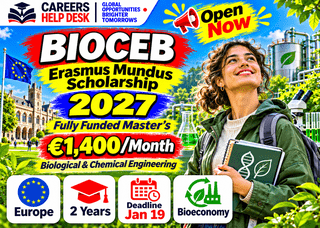
If your interests lean more toward biotechnology, bioprocess engineering, or the sustainable bioeconomy, you can also explore the Bioceb Erasmus Mundus Scholarship 2027. It offers €1,400 per month and participation-cost coverage, with an earlier application deadline of 19 January 2027.
Who Is Eligible for the FIPDes Scholarship 2027?
Applicants from all nationalities may apply, provided they satisfy the academic and language requirements.
Academic qualifications
Candidates must hold a Bachelor’s degree or equivalent qualification representing at least 180 ECTS, or an equivalent three-year higher education programme.
Relevant academic backgrounds include:
- Food Science and Technology
- Biotechnology
- Process Engineering
- Biochemistry
- Nutrition
- Other food-related scientific and engineering disciplines
The selection committee also considers whether applicants have studied relevant subjects such as chemistry, biotechnology, process technology, mathematics, statistics, and biochemistry.
Applicants with an engineering or biotechnology background should examine their transcripts carefully. A degree does not necessarily need to carry the exact title “Food Science,” but applicants must demonstrate suitable preparation for the curriculum.
Can Final-Year Bachelor’s Students Apply?
Yes. Students currently completing their Bachelor’s degree can apply for FIPDes before graduation.
You must provide transcripts covering your completed academic years and an official university document confirming that you are in your final year, including your expected graduation date.
If selected, you must complete your Bachelor’s degree before the programme begins, by the end of August 2027. Failing to complete your degree by the required date will result in your selection being cancelled.
English-language requirements
FIPDes requires English proficiency at approximately CEFR B2 level and accepts several forms of evidence.
| English qualification | Minimum requirement |
|---|---|
| IELTS Academic | 6.5 |
| TOEFL iBT | 90 |
| TOEFL ITP | 575 |
| Cambridge English | Accepted FCE, CAE, or CPE qualifications |
| English-medium university degree | University certificate confirming English as the medium of instruction |
| Native English speakers | Passport evidence |
| More than one year in an English-speaking country | Supporting evidence of the stay |
Exceptional exemptions may be considered for outstanding applicants with a lower English proficiency level, but these are discretionary.
You may therefore apply without IELTS if you qualify through another accepted form of English-language evidence. However, an unsupported claim that your previous education was in English is insufficient.
Important: FIPDes does not accept TOEIC results, general university English tests, or private language-school tests as substitutes for its recognised English-language qualifications.
However, an official university certificate confirming that your higher education degree was taught in English is an accepted form of evidence under the programme’s published requirements. Make sure your document clearly establishes the language of instruction rather than simply stating that you studied English as a subject.
Nationality and scholarship restrictions
The Erasmus Mundus scholarship is open worldwide. However, the consortium applies geographical balance considerations, including a maximum of 10% of regular scholarships for applicants of the same nationality.
Students may benefit from an Erasmus Mundus scholarship only once. Applicants selected for more than one Erasmus Mundus Joint Master must choose which programme to attend.
Applicants interested in environmental sustainability and agricultural science may also consider the IMSOGLO Erasmus Mundus Scholarship 2027. This funded Master’s focuses on soils and global change, with a scholarship deadline of 28 February 2027. Its academic prerequisites differ from those of FIPDes, so review the eligibility requirements before applying.
Required Documents for the FIPDes 2027 Application
Applicants must prepare the following documents:
- Completed online application form.
- Passport scan showing personal details and expiry date, or an accepted identity document for European applicants.
- Curriculum Vitae, preferably in Europass format.
- Motivation letter addressed to the FIPDes Consortium, usually one to two pages.
- Bachelor’s degree certificate or accepted temporary qualification certificate.
- Academic transcripts covering every year of undergraduate study, including the grading system.
- Official translations of qualifications and transcripts where required.
- Two recommendation letters, submitted directly by referees through the application platform.
- Proof of English-language proficiency.
- Proof of residence, issued within the previous 12 months and provided in English or with an official English translation.
Your CV should highlight relevant coursework, laboratory work, internships, technical skills, and academic projects. If you are unsure how to present these experiences, see our guide on how to write an academic CV for Master’s applications, including examples for students without research publications.
Referees may include university teachers, employers, or internship supervisors. FIPDes provides a recommendation letter template, although its use is not compulsory
Incomplete applications are excluded from consideration. Applicants should arrange official transcripts, translations, and recommendation letters well before the deadline.
How Are FIPDes Scholarship Candidates Selected?
The FIPDes Consortium evaluates candidates beyond their basic academic eligibility.
Its published selection criteria include academic subjects and grades, overall educational performance, relevant laboratory or culinary experience, additional training, research activities, international exposure, work experience, and the applicant’s motivation for joining the programme.
The consortium also considers geographical balance when forming the cohort.
Shortlisted applicants may be invited to a mandatory interview lasting approximately 30 minutes. The interview focuses on motivation and the preferred second-year study track.
Being invited to an interview does not guarantee admission or a scholarship.
Careers Help Desk Counter Angle: Your Study Track Should Strengthen Your Scholarship Application
One of the most important decisions for FIPDes applicants is how to connect their previous academic training with the programme’s interdisciplinary curriculum.
For example, a biotechnology graduate might have strong experience in fermentation or biochemical processes but limited exposure to packaging design. A food science graduate might have product-development experience but less training in consumer research.
These differences do not automatically make an applicant unsuitable. The published selection criteria assess the overall academic background, relevant experience, and motivation.
A useful approach is to identify a specific food innovation problem you want to work on, then explain how your previous studies prepare you to investigate it.
Your motivation letter should also connect that interest to the FIPDes curriculum and a suitable second-year specialization. FIPDes recommends a motivation letter of approximately one to two pages, addressed to the FIPDes Consortium. For help connecting your academic background, experience, and study goals, read our guide on how to write a scholarship motivation letter, which includes an Erasmus Mundus-style example.
This matters because shortlisted candidates may be asked about their study-track choice during the interview. A clear, evidence-based explanation will help you demonstrate that you understand the programme you are applying to.
How to Apply for the FIPDes Erasmus Mundus Scholarship 2027
Applications are submitted through the official AgroParisTech Erasmus Mundus application platform.
Step 1: Visit the official application portal and register an account. Verify your email address and select FIPDes from the programme menu.
Register and Apply Here for FIPDes Application 2027 with Fully Funded Scholarship
Sstep 2: Complete the application form and upload the required documents. Enter your referees’ details and send the recommendation requests through the platform.
Step 3: Complete the Erasmus Mundus scholarship application as part of the regular programme application. Review the application and complete the final validation step before the deadline.
- You can save an unfinished application and return later. However, an application that has not been formally validated will not be considered submitted.
- Documents must be uploaded online. Do not send application materials by email or post at this stage.
Note: Applicants who are unsuccessful in the first round cannot reapply in the second round of the same admission cycle. They may, however, apply again in a future intake.
After submitting your application, check for the automatic confirmation email and monitor your inbox and spam folder. FIPDes expects to communicate selection results by April 2027.
Important application dates
| Stage | Date |
|---|---|
| First-round application deadline | 25 January 2027, 14:00 CET |
| Eligibility checks | January–February 2027 |
| Selection stage | End of March 2027 |
| Admission and scholarship results | By April 2027 |
Only first-round applicants can compete for the Erasmus Mundus scholarship. Do not wait for a later admission round if your priority is full funding.
Ready to Apply for Erasmus Scholarship to Study in Europe
The FIPDes Erasmus Mundus Scholarship 2027 is an option for students interested in food innovation, biotechnology, sustainable food processing, and product development who want an internationally structured Master’s degree. With tuition coverage and a monthly allowance of €1,400, the scholarship can make the two-year programme financially accessible to selected applicants. Before applying, check that your undergraduate subjects meet the academic prerequisites, prepare the required evidence of English proficiency, and explain how your experience connects to your preferred FIPDes specialization. Applications for the 2027–2029 cohort close on 25 January 2027 at 14:00 CET.
Official Source: FIPDes Erasmus Mundus Scholarship 2027 Call for Applications
Frequently Asked Questions (FAQs)
1. Is the FIPDes Erasmus Mundus Scholarship 2027 fully funded?
Yes. Selected scholarship holders receive coverage of mandatory participation costs, including tuition and insurance, plus €1,400 per month for up to 24 months. The maximum subsistence allowance is €33,600.
2. Can I apply for FIPDes without IELTS?
Yes. FIPDes accepts other approved evidence, including qualifying TOEFL or Cambridge results and university certification of English-medium higher education.
3. Can students from Pakistan, India, Bangladesh, Nigeria, and other non-EU countries apply?
Yes. The scholarship is open to all nationalities. Applicants must meet the academic and language requirements, and geographical balance is considered during selection.
4. Is a food science degree compulsory?
No. Relevant degrees in biotechnology, process engineering, biochemistry, nutrition, and related fields are also accepted, provided the applicant meets the academic prerequisites.
5. Can I apply directly to the second year of FIPDes?
No. All applicants must enter the first year and successfully complete it before progressing to the second year.
6. What is the deadline for the FIPDes 2027 scholarship?
The first-round deadline is 25 January 2027 at 14:00 CET. Scholarship applicants must apply in this round.
Stay connected with Careers Help Desk for the latest international fellowships, scholarships, research opportunities and jobs abroad to empower your future!

0 Comments