Applications are open for the KAUST Fellowship 2027, offering fully funded Master’s, MS/PhD, and PhD opportunities at King Abdullah University of Science and Technology (KAUST) in Saudi Arabia. Funding includes full tuition coverage, an annual stipend of US$20,000 for Master’s students and US$25,000–30,000 for PhD students, accommodation, health insurance, and relocation support. International students with relevant academic qualifications and a minimum GPA of 3.0/4.0 (or equivalent) can apply for programmes in engineering, computer science, artificial intelligence, biological sciences, mathematics, environmental sciences, and related fields.
The Fall 2027 application deadline is 3 January 2027, and the semester begins on 29 August 2027. There is no separate scholarship application; fellowship support is normally provided through graduate admission, subject to applicable sponsorship arrangements.
KAUST Fellowship 2027: Quick overview
| Details | Information |
|---|---|
| University | King Abdullah University of Science and Technology (KAUST) |
| Country | Saudi Arabia |
| Academic intake | Fall 2027 |
| Degree levels | Master’s (MS), MS/PhD, PhD |
| Funding | Fully funded KAUST Fellowship |
| Annual MS stipend | US$20,000 |
| Annual PhD stipend | US$25,000–30,000 |
| Other benefits | Tuition, accommodation, health insurance, relocation |
| Nationality | International and Saudi applicants |
| Minimum GPA | 3.0/4.0 or equivalent |
| Application fee | Free |
| Application deadline | 3 January 2027 |
| Application status | Open |
| Application method | Online |
KAUST Fellowship vs KAUST Global Fellowship: The graduate KAUST Fellowship described here supports Master’s, MS/PhD, and PhD students. It is different from the KAUST Global Fellowship, a separate programme for early-career researchers who have completed or are nearing completion of a PhD. The two programmes have different application processes, funding arrangements, and deadlines.
What does the KAUST Fellowship 2027 cover?
The KAUST Fellowship provides financial support throughout eligible graduate studies, allowing students to concentrate on coursework and research.
According to the university’s official funding information, the fellowship includes:
- Full tuition and bench fees: Coverage valued at up to US$35,000 annually.
- Living stipend: US$20,000 per year for MS students and US$25,000–30,000 for PhD students, depending on qualifications and academic progress.
- Accommodation: Base university housing, including shared accommodation for single students and two-bedroom accommodation for married students.
- Health insurance: Coverage for students and eligible dependents living on campus.
- Relocation assistance: Support for visas, relocation, and travel associated with the initial move to KAUST and return home after graduation.
KAUST estimates the overall fellowship package at approximately US$70,000–80,000 annually, depending on individual circumstances.
However, this figure represents the combined value of tuition, housing, insurance, stipend, and other benefits. It is not the amount students receive as cash. Housing upgrades may involve additional charges, and students with substantial external sponsorship may receive different funding arrangements.
For married applicants and externally funded students: KAUST includes standard two-bedroom accommodation for married students, while larger or upgraded housing may involve additional charges. Health insurance is provided for eligible dependents living on campus.
Applicants receiving substantial external sponsorship for tuition, living expenses, or relocation must disclose that funding to KAUST. Such sponsorship may affect or replace the KAUST Fellowship. Smaller awards supporting activities such as conference travel or computer purchases are treated differently under the university’s funding rules.
KAUST also states that the fellowship does not cover the cost of taking an English proficiency examination.
For applicants comparing KAUST with other funding options, our guide on how to find fully funded scholarships abroad explains how to verify tuition coverage, living allowances, eligibility restrictions, and scholarship conditions before applying.
Available Master’s and PhD programmes at KAUST
KAUST is a graduate research university in Thuwal, near Jeddah, with programmes across science, technology, mathematics, and engineering.
Applicants can explore research areas including:
| Academic area | Examples of programmes |
|---|---|
| Computer and Mathematical Sciences | Computer Science, Applied Mathematics, Statistics |
| Electrical Engineering | Electrical and Computer Engineering |
| Biological Sciences | Bioscience, Bioengineering, Plant Science |
| Environmental Sciences | Environmental Science and Engineering, Marine Science |
| Chemical and Physical Sciences | Chemistry, Chemical Engineering, Materials Science |
| Mechanical and Earth Sciences | Mechanical Engineering, Earth Science and Engineering |
Applicants interested in artificial intelligence, renewable energy, water treatment, biotechnology, and computational modelling can explore relevant research groups within these programmes.
KAUST offers three main graduate pathways: an MS degree, a research-focused PhD, and an integrated MS/PhD pathway.
The integrated pathway allows eligible students entering after a bachelor’s degree to progress towards doctoral study without submitting a second PhD admission application, provided they meet the progression requirements. Not every academic programme offers this pathway.
Check the official KAUST programmes directory before selecting your degree.
Exploring other research opportunities? If you are considering a fully funded PhD outside Saudi Arabia, Singapore’s Nanyang Technological University also offers the Nanyang President’s Graduate Scholarship 2027–2028. The scholarship supports international PhD applicants across various research disciplines, with tuition coverage, a monthly stipend, and additional allowances. Applications close on 31 December 2026.
Who is eligible for the KAUST Fellowship 2027?
KAUST welcomes applicants from different countries and educational backgrounds. Admission is competitive, and meeting the minimum requirements does not guarantee an offer.
The university’s current entry requirements include:
- A relevant bachelor’s degree from a recognised institution for Master’s admission.
- A relevant Master’s degree for standard PhD admission, subject to the requirements of the selected pathway.
- A minimum GPA of 3.0 on a 4.0 scale or equivalent.
- Applicants must be at least 18 years old when entering KAUST.
- Evidence of English proficiency, unless an official exemption applies.
Important for PhD applicants: KAUST’s standard PhD entry requirements specify a relevant Master’s degree. Applicants with only a bachelor’s degree should explore the integrated MS/PhD pathway, where available. KAUST also cautions that professional Master’s qualifications are not automatically treated as equivalent to other Master’s degrees, so applicants with these qualifications should check their eligibility carefully.
KAUST reports that approximately 90% of admitted applicants have a GPA above 3.3, while 75% have a GPA above 3.5.
These figures are useful for understanding admission competitiveness. A GPA of 3.0 satisfies the published minimum but should not be interpreted as a typical admitted student’s academic profile.
KAUST assesses applications holistically, considering academic achievement, motivation, research interests, and potential contributions to the scientific community.
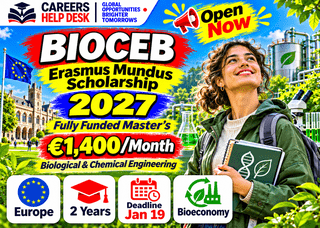
Looking for fully funded Master’s scholarships in Europe? If your academic background or study preferences do not align with KAUST, you can also explore the Bioceb Erasmus Mundus Scholarship 2027. This two-year European Master’s programme focuses on biotechnology and the sustainable bioeconomy, offering selected students €1,400 per month and coverage of programme participation costs. The application deadline is 19 January 2027.
English language requirements: Can you apply without IELTS?
Yes. You can submit a KAUST application without an English test score, but this does not automatically exempt you from the language requirement.
Under the current admissions rules, the standard accepted scores are:
| English test | Standard minimum |
|---|---|
| IELTS | 7.0 overall, minimum 6.5 in each section |
| TOEFL iBT | 5 overall, minimum 4.5 in each section (2026 scoring scale) |
| PTE Academic | 71 overall, minimum 67 in each section |
| Cambridge C1/C2 | 185 overall, minimum 176 in each section |
KAUST also publishes conditional admission thresholds for Saudi nationals and PhD students, including IELTS 6.5 overall with at least 6.0 in each section, subject to an Academic English Language Communication Course.
An English test exemption is available to applicants who completed an eligible degree through in-person study at an accredited institution in the United States, Canada, the United Kingdom, Ireland, Australia, or New Zealand, or previously completed a degree at KAUST’s Thuwal campus.
Importantly, a Medium of Instruction certificate alone does not qualify for exemption. KAUST also does not accept Duolingo for regular graduate admissions.
Applicants without an exemption must satisfy the applicable English requirements before enrolment, even if they initially apply without test results.
Always consult the current KAUST English requirements, rather than relying on older scholarship announcements that quote IELTS 6.5 or TOEFL iBT 81 as universal requirements.
Required documents for the KAUST Fellowship application
Applicants should prepare the following documents before starting their online application:
- Academic transcripts and relevant degree records from previously attended higher education institutions.
- An updated academic or professional CV.
- A statement of purpose of approximately 750 words explaining academic preparation, research interests, intended field of study, and career objectives.
- Contact details for three referees, using academic or professional email addresses.
- English proficiency results, where available or required.
- A clear copy of the passport information page, or an accepted national ID for Saudi applicants.
Transcripts issued in another language must be accompanied by certified English translations. Applicants who have not yet completed their current degree may submit available academic records initially, but final official documents will be required before enrolment.
Your CV should highlight your education, research experience, relevant projects, and technical skills. If you are preparing one for the first time, our guide on how to write an academic CV includes examples for Master’s and PhD applicants, including students without publications.
KAUST’s statement of purpose should explain your academic preparation, research interests, programme choice, and future goals. Our guide on how to write a statement of purpose for Master’s and PhD applications provides structures and examples to help you prepare a focused statement.
KAUST requires three recommendations, normally from academic referees. Applicants who completed their most recent higher education qualification more than three years ago may use professional referees instead. Referees must have academic or professional email addresses, as personal email addresses are not accepted.
Reference requests are sent automatically when you enter your referees’ details, even before submitting the application. KAUST expects the letters within seven calendar days after the application deadline. For Fall 2027, this means applicants should arrange submission by 10 January 2027, based on the published 3 January deadline. Confirm the deadline with KAUST if the admissions schedule changes..
The GRE and PGAT are optional. Strong results may support an application, but neither examination is compulsory.
Do you need a research proposal? KAUST’s general graduate application requires a statement of purpose of approximately 750 words. A separate research proposal is not listed among the standard application documents. Research-focused applicants should still explain their academic interests, previous research experience, and reasons for choosing their programme. Always check whether the selected programme requests additional materials.
How does KAUST select Master’s and PhD applicants?
KAUST considers academic performance alongside evidence of research potential and suitability for the chosen programme.
The university’s published admissions guidance places particular importance on academic achievement, motivation, research interests, and personal qualities.
For research-oriented applicants, this means the statement of purpose should clearly connect previous academic or technical experience with the research they want to pursue.
Applicants should also choose referees who can provide specific evidence of their academic performance, research ability, and independent work.
KAUST may contact shortlisted MS/PhD and PhD candidates for discussions with relevant faculty members. An interview or faculty discussion may therefore form part of the assessment process.
Careers Help Desk Counter Angle: Research fit matters more than applying to every available field
One important restriction can easily be overlooked: KAUST permits only one academic programme application per year.
This makes programme selection especially important for applicants whose experience overlaps several disciplines.
For example, a student with a chemical engineering background and experience in computational modelling might consider Chemical Engineering, Environmental Science and Engineering, or Applied Mathematics.
Rather than choosing a programme solely because it appears closely related to their degree title, applicants should examine the research conducted by KAUST faculty.
A practical approach is to identify two or three faculty members working on relevant problems, review their recent research, and determine which academic programme provides the strongest fit.
KAUST does not require applicants to secure a supervisor or contact faculty before applying. However, MS/PhD and PhD applicants can indicate faculty members they would be interested in working with.
This research can make the statement of purpose more specific and help applicants avoid using their single annual application on a poorly matched programme.
Although a separate research proposal is not part of KAUST’s standard graduate application requirements, PhD applicants may find it useful to organize their research interests into clear questions and potential methods. Our guide on how to write a PhD research proposal explains how to develop a realistic research direction.
How to apply for the KAUST Fellowship 2027
Applications are submitted through KAUST’s official graduate admissions system.
Step 1: Choose your programme. Review the available MS, MS/PhD, and PhD options and confirm that your qualifications meet the entry requirements.
KAUST MS and PhD Programs across 17 STEM disciplines
Step 2: Review relevant faculty research. Identify the research topics that best match your academic background and interests. (KAUST Faculty List Here)
Step 3: Create an admissions account. Visit the official KAUST application portal and register. Complete your application. Enter your academic details, upload the required documents, and provide your statement of purpose.
Apply Here for KAUST Master and PhD Admisson Application
Step 4: Register your referees. Enter three eligible referees and allow sufficient time for their recommendations.
Step 5: Submit before 3 January 2027. Check your application carefully because changes after submission are restricted.
Step 6: Monitor your application. Respond promptly if KAUST requests additional documents or invites you to an interview.
There is no application fee and no separate KAUST Fellowship application.
KAUST Fellowship 2027 application deadlines
| Admission activity | Official date |
|---|---|
| Fall 2027 applications opened | 28 September 2026 |
| Application deadline | 3 January 2027 |
| Expected decisions | 25 February 2027 |
| Fall semester begins | 29 August 2027 |
The Spring 2027 PhD application deadline of 27 September 2026 has already passed.
KAUST describes the published timeline as tentative, so applicants should monitor official announcements for changes.
Ready to Apply for KAUST KSA Fellowships 2027
The KAUST Fellowship 2027 provides a fully funded route to graduate study in Saudi Arabia for students pursuing science, engineering, mathematics, and related research disciplines. Applicants should pay particular attention to the university’s current English language requirements, competitive academic expectations, and restriction to one programme application per year. With the Fall 2027 deadline set for 3 January 2027, prospective students should begin preparing their statement of purpose, academic documents, and referee details well before the closing date. For the latest information, visit the official KAUST admissions website.
Official Source: KAUST Admission for Master and PhD with Fully Funded Fellowship 2027
Frequently asked questions (FAQs)
1. Is the KAUST Fellowship 2027 fully funded?
Yes. The fellowship includes tuition coverage, a living stipend, accommodation, health insurance, and relocation support. Students with external sponsorship or specific partnership funding may have different arrangements.
2. Can international students apply for KAUST scholarships?
Yes. KAUST welcomes applicants from around the world, provided they meet the relevant academic and admission requirements.
3. Can I apply to KAUST without IELTS?
Yes, applications can be submitted before an English score is available. However, applicants who do not qualify for an exemption must meet KAUST’s language requirements before enrolment.
4. Is a supervisor required before applying?
No. KAUST does not require you to secure a supervisor or contact faculty before submitting your application. You may identify faculty members whose research interests align with yours, and shortlisted applicants may be contacted for further discussions. If you decide to make a preliminary inquiry, our guide on how to email a professor for PhD opportunities explains how to write a concise, research-focused message. Contacting faculty does not replace the official KAUST application.
5. Can I apply for a KAUST PhD with only a bachelor’s degree?
KAUST offers an integrated MS/PhD pathway for eligible bachelor’s degree holders. Standard PhD entry requirements on the current admissions page specify a relevant Master’s degree, so applicants should choose the pathway appropriate to their qualifications.
6. Is there an application fee or a separate scholarship application?
No. KAUST graduate admission applications are free, and eligible admitted students are automatically considered for the KAUST Fellowship. Funding terms are confirmed in the admission offer.
Stay connected with Careers Help Desk for the latest international fellowships, scholarships, research opportunities and jobs abroad to empower your future!



0 Comments