The Bioceb Erasmus Mundus Scholarship 2027–2029 offers international students a fully funded, two-year master’s degree in biological and chemical engineering across universities in France, Finland, Belgium, and Estonia. Selected students receive €1,400 per month for up to 24 months, plus full coverage of programme participation costs. The maximum monthly allowance total is €33,600 over the two-year programme.
Applications are open to all nationalities. Candidates must hold a relevant science or engineering bachelor’s degree of at least 180 ECTS, including coursework in a biology-related discipline, and meet the programme’s English-language requirements. The application deadline is January 19, 2027, at 11:30 a.m. Paris time (CET). Bioceb is particularly relevant to applicants interested in biotechnology, bioprocess engineering, sustainable materials, and the bioeconomy.
Bioceb Erasmus Mundus Scholarship 2027: Quick Overview
| Detail | Information |
|---|---|
| Programme | European Master in Biological and Chemical Engineering for a Sustainable Bioeconomy (Bioceb) |
| Scholarship | Erasmus Mundus Joint Masters (EMJM) |
| Intake | 2027–2029 |
| Host countries | France, Finland, Belgium, Estonia |
| Participating universities | 5 European universities |
| Degree level | Master’s |
| Duration | 2 years (120 ECTS) |
| Monthly allowance | €1,400 |
| Maximum allowance | €33,600 over 24 months |
| Participation costs | Fully covered for scholarship recipients |
| Eligible nationalities | All nationalities |
| Teaching language | English |
| Application status | Open |
| Deadline | January 19, 2027, 11:30 a.m. CET |
| Application method | Online |
What Is the Bioceb Erasmus Mundus Master’s Programme?
Bioceb is a two-year Erasmus Mundus Joint Master designed to prepare graduates for careers in biotechnology, sustainable industrial processes, and the bio-based economy.
The programme combines biological sciences, chemical engineering, environmental assessment, and industrial innovation. Students learn how biological resources can be converted into valuable products while reducing dependence on fossil-based materials.
The consortium consists of five universities:
- Université de Reims Champagne-Ardenne (URCA) – France
- AgroParisTech / Université Paris-Saclay – France
- Aalto University – Finland
- University of Liège (ULiège) – Belgium
- Tallinn University of Technology (TalTech) – Estonia
Students study at multiple institutions according to their assigned study track. Successful completion leads to a triple master’s degree, with qualifications awarded through the participating universities in the chosen pathway.
The programme also includes research projects, industry-related activities, and a master’s thesis internship.
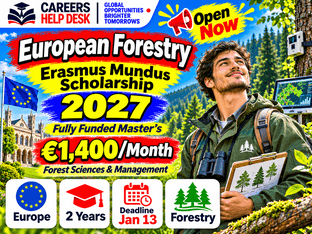
Students interested in forest resources, sustainable biomass management, and climate-related research can also consider the European Forestry Erasmus Mundus Scholarship 2027. Its funded master’s programme has a January 13, 2027 application deadline and requires a separate motivation video by January 20, 2027.
Bioceb Scholarship Benefits: What Does the Funding Cover?
The Erasmus Mundus Master scholarship provides financial support throughout the two-year programme.
| Funding component | Coverage |
|---|---|
| Monthly subsistence allowance | €1,400 |
| Maximum scholarship duration | 24 months |
| Maximum total allowance | €33,600 |
| Participation and tuition costs | Fully covered |
| Insurance | Included in programme participation coverage |
| Travel and visa expenses | Supported through the monthly allowance |
| Installation and living expenses | Supported through the monthly allowance |
| Research and thesis activities | Covered according to programme requirements |
The €1,400 monthly allowance is intended to help students meet living, travel, visa, and relocation expenses. These are not separate guaranteed cash payments in addition to the stipend.
Bioceb has funding for 50 regular Erasmus Mundus scholarships across the project, approximately 12 per cohort, with up to 18 additional scholarships for applicants from designated world regions over the full project period.
Regular scholarships are open to all nationalities, but Bioceb applies a geographical balance rule: no more than 10% of the total project scholarships may be awarded to candidates of the same nationality. Applicants should therefore not interpret worldwide eligibility as a guarantee of equal scholarship availability for every nationality or intake.
These figures apply to the overall funding period, not exclusively to the 2027 intake. Scholarship awards remain competitive.
Can you study Bioceb without an Erasmus Mundus scholarship?
Yes. Bioceb also admits self-funded students.
| Student category | Annual participation cost | Two-year total |
|---|---|---|
| Non-EU / specified third-country category | €9,000 | €18,000 |
| EU / associated-country category | €4,500 | €9,000 |
Self-funded students must also budget for living expenses, travel, and visas. A €1,000 deposit is required upon receiving an admission offer to confirm a self-funded place.
Eligible self-funded students may seek Erasmus+ second-year mobility support, approximately €200–€300 per month depending on the destination. This is supplementary funding, not a replacement for the full scholarship.
If you are considering a self-funded place, begin looking for external funding before committing to the programme’s participation costs. Our guide on how to find fully funded scholarships abroad explains how to compare scholarship benefits, check eligibility, and identify funding opportunities through official sources.
Who Is Eligible for the Bioceb Erasmus Mundus Scholarship?
Applicants must meet the following minimum admission requirements:
- Hold a Bachelor of Science or equivalent qualification of at least 180 ECTS in engineering or science.
- Have completed coursework in at least one biology-related discipline, such as biotechnology, biochemistry, microbiology, biophysics, bioprocess engineering, or molecular biology.
- Demonstrate the required English-language proficiency.
- Submit a complete application before the deadline.
Experience with biomass and a combination of chemistry and biology knowledge are particularly valued.
Final-year bachelor’s students can also apply if they provide university confirmation of their current status and expected graduation date.
Important: An engineering degree alone does not automatically establish eligibility. Applicants should check whether their transcripts demonstrate the required biology-related coursework.
Applicants who previously received an Erasmus Mundus scholarship cannot receive another EMJM scholarship under Bioceb.
If your academic background is more focused on animal biology, genetics, or biodiversity than bioprocess engineering, the EMABG Erasmus Mundus Scholarship 2027 may be another option. It provides €1,400 per month to selected scholarship recipients, with applications closing on January 15, 2027.
English language requirements
Bioceb accepts the following English-language qualifications:
| Test | Minimum requirement |
|---|---|
| IELTS Academic | Overall 6.5, Writing at least 6.0 |
| TOEFL iBT (previous scoring scale) | Overall 92, Writing at least 22 |
| TOEFL iBT (new scoring scale) | Writing at least 4.5, with an old-scale overall equivalent of 92 during the transition |
| Pearson PTE Academic | Overall 62, Writing at least 54 |
| Cambridge C1 Advanced | Grade A, B, or C |
| Cambridge C2 Proficiency | Grade A, B, C, or Level C1 |
Bioceb also accepts specified TOEFL paper-delivered scores and the TOEFL iBT Home Edition.
Can you apply without IELTS or TOEFL? Yes, but only if you meet Bioceb’s specific exemption conditions or submit another accepted language qualification.
Bioceb permits an English-test exemption for applicants who have earned a degree in an English-medium programme at a qualifying higher education institution of applied sciences in an EU/EEA country, or in an English-speaking country where English is an official language. Applicants must provide a certificate from their university confirming the language of instruction.
An English-medium degree from an institution outside these conditions does not automatically qualify. If your circumstances are unclear, request confirmation from the Bioceb Secretariat before relying on an exemption.
Study Tracks and Research Specialisations
Bioceb offers a structured curriculum combining common training with specialist pathways.
| Semester | Location | Main focus |
|---|---|---|
| Semester 1 | URCA, France | Agro-resources, biorefinery, multidisciplinary foundations |
| Semester 2 | AgroParisTech, France, or TalTech, Estonia | Sustainability assessment, economics, or green chemistry |
| Semester 3 | AgroParisTech, ULiège, or Aalto | Biomass engineering, bioprocesses, or bio-based products |
| Semester 4 | Approved internship/research location | Research internship and master’s thesis |
Applicants must select two preferred study tracks, rank them, and justify both choices in their motivation letter.
Final track allocation depends on academic suitability and available places. Receiving admission does not guarantee assignment to the first-choice pathway.
Students must also satisfy Erasmus Mundus mobility rules, including qualifying study periods in two countries different from their country of residence at enrolment.
Applicants interested in environmental sustainability, soil science, and natural resource management may also explore the IMSOGLO Erasmus Mundus Scholarship 2027. It offers a different scientific specialisation, with Erasmus Mundus funding available for eligible applicants and a scholarship application deadline of February 28, 2027.
Required Documents for Bioceb Applications
Prepare the following documents before completing the online application:
- Valid passport (or national identity card for eligible European applicants).
- Proof of current residence showing your name, address, and date.
- English-language CV, preferably in Europass format.
- Motivation letter of no more than two pages.
- Bachelor’s degree certificate or official final-year confirmation.
- Official bachelor’s transcripts, including grading-system information.
- Two recommendation letters from different referees.
- Accepted proof of English proficiency or qualifying exemption documentation.
- High school diploma or equivalent records.
- Required translations of academic documents.
- Official documents explaining periods since graduation, where applicable.
- Supporting documents for individual needs or vulnerability, where applicable.
The motivation letter must use an accepted standard font, 11-point size, 1.15 line spacing, and 2 cm margins. Your motivation letter should explain how your previous studies and experience connect with Bioceb and why you selected your two preferred study tracks. If you need help organising these points, see our guide on how to write a scholarship motivation letter, which includes an Erasmus Mundus-style example. Follow Bioceb’s specific two-page limit and formatting requirements.
Referees must upload their recommendation letters directly through the application system. Applicants cannot substitute their own uploads.
The application portal also requires a document in its diploma-translation field even when the original degree is already in English. In that case, upload the English diploma again.
Important for proof of residence: The application portal requires a document dated within three months before the January 19, 2027 deadline. The Bioceb programme instructions separately refer to three months before applications opened on November 3, 2026. To avoid problems, applicants should use a recently issued document that satisfies both periods where possible. If uncertain, contact the Bioceb Secretariat at bioceb@agroparistech.fr before submitting.
Bioceb prefers a European-style CV in English, submitted as a PDF. Include your education, relevant scientific projects, internships, technical skills, and work experience. Our guide on how to write an academic CV for master’s applications provides examples and explains how to present research experience even if you have no publications.
How Are Bioceb Scholarship Applicants Selected?
Bioceb states that each cohort can include a maximum of 25 students. Admission is competitive, and not every admitted student receives an Erasmus Mundus scholarship. Applicants are assessed through academic records, relevant experience, motivation, recommendation letters, and an interview for shortlisted candidates. Bioceb publishes the weighting used to assess applications.
| Selection criterion | Weight |
|---|---|
| Academic excellence | 35% |
| Experience and activities | 10% |
| Motivation letter | 20% |
| Recommendation letters | 10% |
| Online interview | 25% |
| Total | 100% |
Academic assessment considers the relevance of previous studies, grades, GPA, and university ranking. For this criterion, Bioceb considers bachelor’s degree results even when an applicant also holds a master’s degree.
Shortlisted applicants attend an online interview lasting approximately 20–30 minutes. The interview assesses motivation, communication, interpersonal skills, and the reasons behind the selected study tracks.
Applicants are expected to receive selection results in April 2027.
Careers Help Desk Counter Angle: Your Study Track Choices Can Affect Your Application
One important aspect of Bioceb is that applicants must explain two study-track preferences before admission.
This matters because the motivation letter accounts for 20% of the selection assessment, while the interview contributes another 25%. Bioceb specifically evaluates whether applicants understand the programme and can justify their chosen pathways.
For example, a candidate with experience in fermentation or microbial engineering could explain how that background connects with the bioprocess specialisation. Someone interested in sustainable materials might instead demonstrate how previous chemistry or biomass-related projects support a bio-based products pathway.
Before applying, compare your bachelor’s coursework, laboratory experience, and career goals against both preferred tracks.
Your motivation letter should make that connection clear, rather than discussing sustainable development only in general terms. Be prepared to explain the same choices during the interview.
This approach follows Bioceb’s published assessment requirements and helps applicants demonstrate a coherent academic plan.
How to Apply for the Bioceb Erasmus Mundus Scholarship 2027
Applications are submitted through the official AgroParisTech Erasmus Mundus application platform.
Step 1: Visit the official Bioceb application portal. Register an account or log in forBioceb Applications (cohort 2027–2029).
Apply Here for Bioceb Applications (cohort 2027-2029) to Study in Europe with Scholarship
Step 2: Complete the application form and rank your two preferred study tracks.
Step 3: Upload all required documents and translations.
Step 4: Enter the email addresses of your two referees so they can submit their letters.
Step 5: Check every application section and complete the final validation step before the application deadline: January 19, 2027, at 11:30 a.m. CET (Paris time).
- Applications for the Erasmus Mundus scholarship are made through the same programme application process. There is no separate scholarship application form.
- An application saved as a draft is not considered submitted. Bioceb requires final validation, and incomplete applications are excluded.
Ready to Apply for Eramus Mundus Master Scholarship in Europe
The Bioceb Erasmus Mundus Scholarship 2027–2029 is particularly relevant to science and engineering graduates interested in biotechnology, biorefineries, sustainable materials, and industrial bioeconomy research. The programme offers substantial funding, but applicants must demonstrate relevant academic preparation, meet the English-language requirements, and justify their preferred study tracks. Before the January 19, 2027 deadline, prioritise obtaining official transcripts, confirming language eligibility, and arranging referee submissions. All documents must be uploaded and the application fully validated through the official portal. For complete requirements, consult the Bioceb application procedure, scholarship information, and selection criteria.
Official Source: Bioceb Erasmus Mundus Programme 2027–2029 Call for Applications
Frequently Asked Questions (FAQs)
1. Is the Bioceb Erasmus Mundus Scholarship fully funded?
Yes. Scholarship recipients receive full participation-cost coverage and €1,400 per month for up to 24 months, giving a maximum subsistence allowance of €33,600. Travel, visa, installation, and living expenses must be managed within this allowance.
2. Can students from Pakistan, India, Bangladesh, Nigeria, and other non-EU countries apply?
Yes. Bioceb accepts scholarship applicants from all nationalities, subject to programme eligibility and Erasmus Mundus funding rules. Scholarship allocations also follow geographical balance requirements.
3. Can I apply without IELTS?
Yes, if you meet Bioceb’s specific English-language exemption conditions or provide another accepted English test. An English-medium degree from any university does not automatically qualify for an exemption.
4. Can final-year bachelor’s students apply?
Yes. You must provide official confirmation that you are in your final year, together with your expected graduation date.
5. Do I need to contact a professor before applying to Bioceb?
The published Bioceb application procedure does not require applicants to obtain a professor’s agreement before applying. Candidates apply directly through the official consortium portal, and the fourth semester includes a research internship and master’s thesis. You should focus on meeting the admission requirements, preparing the required documents, and explaining your preferred study tracks.
6. How many Bioceb Erasmus Mundus scholarships are available?
The programme has 50 regular EMJM scholarships for the overall funded project, approximately 12 per cohort, with up to 18 additional region-targeted scholarships across the project. These are not guaranteed allocations for every intake.
7. When will Bioceb announce the 2027 selection results?
Bioceb expects to notify applicants in April 2027. Shortlisted candidates must complete an online interview before final selection.
Stay connected with Careers Help Desk for the latest international fellowships, scholarships, research opportunities and jobs abroad to empower your future!

0 Comments