The AToUT Postdoctoral Fellowship Programme 2027 is accepting applications for 15 funded postdoctoral research positions at the University of Toulouse in France. Selected researchers will receive a 24-month full-time employment contract, with a minimum gross monthly salary of €3,393.58, social security coverage, research support, and career development opportunities.
The programme is co-funded by the European Union through the Marie Skłodowska-Curie Actions (MSCA COFUND) under Horizon Europe. Applications are open to researchers of all nationalities who hold a PhD or equivalent qualification and satisfy the MSCA mobility requirements. The application deadline is 26 February 2027 at 17:00 Paris time. Fellowships are expected to begin in November 2027.
AToUT is an MSCA COFUND-supported postdoctoral programme, not the separate MSCA Postdoctoral Fellowships (MSCA-PF) call. Applicants apply directly through the AToUT recruitment platform rather than submitting an individual MSCA-PF proposal through the European Commission’s Funding & Tenders Portal. The eligibility and evaluation requirements described here apply specifically to AToUT.
AToUT Postdoctoral Fellowship 2027: Quick Overview
| Programme details | Information |
|---|---|
| Fellowship | AToUT Postdoctoral Fellowship Programme |
| Host country | France |
| Coordinating institution | University of Toulouse |
| Funding | Horizon Europe, MSCA COFUND |
| Available positions | 15 |
| Duration | 24 months |
| Minimum gross salary | €3,393.58 per month |
| Eligible nationalities | All nationalities |
| Academic qualification | PhD or equivalent |
| Research areas | Health, global changes, sustainable transitions |
| Application opens | 3 November 2026 |
| Application deadline | 26 February 2027, 17:00 CET |
| Interviews | 23–25 June 2027 |
| Expected start | November 2027 |
| Application method | Online |
The 2027 recruitment is the programme’s second call. AToUT plans to support 44 postdoctoral researchers across three calls, with 15 positions available in this round.
What Does the AToUT Postdoctoral Fellowship Cover?
AToUT offers an employment-based research fellowship rather than a conventional scholarship. Successful applicants will be employed by an eligible French host institution and receive the benefits associated with their employment contract.
The official 2027 applicant guide provides the following financial breakdown:
| Funding component | Amount |
|---|---|
| Living allowance | €5,200/month |
| Mobility allowance | €350/month |
| Family allowance, if applicable | €350/month |
| Research, training and mobility budget | €1,250/month |
| Minimum gross monthly salary | €3,393.58 |
How much will fellows actually receive?
The minimum gross salary confirmed for the 2027 recruitment is €3,393.58 per month, before applicable deductions. This is the clearest published figure for applicants assessing their expected employment income.
The applicant guide also lists a €5,200 living allowance, €350 mobility allowance, and an additional €350 family allowance where applicable. These figures should not be added together and treated as take-home salary. The programme’s FAQ clarifies that allowances form part of the overall compensation package.
A separate €1,250 monthly allocation supports research, training, and mobility-related activities. It is not a personal salary supplement. Fellows can use this budget for eligible activities such as laboratory analyses, specialist training, and conferences.
Before accepting an offer, applicants should request a breakdown of the gross salary, estimated net pay, applicable family benefits, and research funding arrangements from their prospective employing institution.
Research Areas and Eligible Disciplines
AToUT supports interdisciplinary research addressing three major themes.
1. Health and well-being
Research may include personalised medicine, healthy ageing, biotechnology, artificial intelligence in healthcare, and the relationship between environmental conditions and human health.
2. Global changes and their impact on societies
Relevant topics include climate change adaptation, environmental and social transformations, public policy, economic models, and the societal implications of emerging technologies.
3. Sustainable transitions
This theme includes renewable energy, sustainable mobility, circular economy, innovative materials, environmental technologies, and responsible industrial development.
Projects must also connect to an eligible disciplinary cluster within the Toulouse research community.
| Cluster | Research disciplines |
|---|---|
| BABS | Biology, Agronomy, Biotechnology, Health |
| DSPEG | Law, Political Science, Economics, Finance |
| H-SHS | Humanities and Social Sciences |
| MST2I | Mathematics, Information Technology, Engineering |
| SDM | Chemistry and Materials Sciences |
| UPEE | Universe, Planetary Sciences, Space, Environment |
Applicants can explore the participating research community through the official University of Toulouse Research Directory.
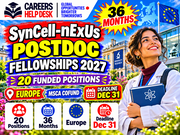
Researchers working in synthetic biology, molecular biology, biophysics, or related interdisciplinary fields may also consider the SynCell-nExUs Postdoctoral Fellowships 2027 in Europe. This separate MSCA COFUND programme offers 20 funded positions lasting 36 months, with applications closing on 31 December 2026. Its research scope, host requirements, and mobility conditions differ from AToUT.
Who Is Eligible for the AToUT Fellowship 2027?
Applicants must satisfy the following conditions:
- Hold a PhD or equivalent doctoral degree by 26 February 2027. Researchers who have successfully defended their thesis but have not received the diploma may provide official proof of the defence.
- Have spent no more than 12 months residing or carrying out their main activity in France during the 36 months immediately before the deadline.
- Have at least B2-level proficiency in English or French.
- Not hold a permanent position at the proposed host institution.
- Propose a full-time research project that has not already received EU funding for the same work.
- Identify an eligible host research unit affiliated with AToUT.
There is no nationality restriction, age limit, or maximum number of years since completing a PhD. Researchers with several years of postdoctoral experience may apply if they meet the other requirements.
The mobility rule is particularly important. French nationality does not automatically disqualify an applicant, and a previous PhD completed in France does not necessarily make someone ineligible. What matters is the time spent living or conducting the main activity in France during the relevant 36-month period.
How to check the 12-month mobility rule
For the 2027 call, applicants must assess their residence and main professional or academic activity in France during the 36 months immediately preceding 26 February 2027.
For example, someone who spent eight months working in France during that period and then moved abroad may satisfy the mobility rule, provided no other qualifying time in France brings the total above 12 months. Someone who spent 18 months studying or working in France during the same period would normally fail this requirement.
Short visits such as holidays and periods covered by the programme’s refugee provisions are treated differently under the published rules. Applicants with complicated travel or employment histories should confirm their circumstances with the AToUT team before submitting.
Do You Need a Supervisor Before Applying?
Applicants must identify an eligible host research unit and provide host and supervision information in their application.
Although the programme does not make prior supervisor confirmation an absolute eligibility condition, applicants must identify a suitable AToUT-affiliated host research unit and provide supervision information.
Before submitting, contact the relevant research group to discuss the proposed topic, available facilities, and potential supervision arrangements. Where possible, obtain written confirmation of the laboratory’s interest, although the published requirements do not establish a signed host acceptance letter as mandatory for every applicant.
This is particularly valuable because the interview assessment considers the suitability of the hosting team and its connection to the proposed research.
If you are approaching a Toulouse research group for the first time, keep your message focused on research compatibility and the laboratory’s expertise. Our guide to emailing professors about research opportunities includes examples of concise academic inquiries. Adapt the approach for a postdoctoral application rather than asking about PhD admission.
Required Documents for the AToUT Application
The official call and applicant guide identify these application materials:
- Completed online application form and personal information.
- Academic CV and motivation letter.
- PhD diploma or official successful-defence certificate.
- Description of previous research experience.
- Research proposal, maximum 10 pages, covering objectives, hypotheses, methodology, feasibility, impact, budget use, and alignment with AToUT priorities.
- Host research unit and supervision information.
- Ethics self-assessment.
Your academic CV should make your research experience, publications, technical skills, and contributions easy to assess. If you need help organizing these details, see our guide to writing an academic CV for master’s, PhD, and postdoctoral applications, which includes examples and practical formatting advice.
The research proposal is particularly important because AToUT evaluates scientific novelty, methodology, impact, and feasibility. Our research proposal writing guide with examples explains how to develop a research question, identify a knowledge gap, and present a realistic methodology. Although the examples focus on PhD applications, these principles also apply to postdoctoral proposals. Follow AToUT’s official 10-page limit and application instructions.
Applicants should follow the official application platform’s instructions for formatting, supporting documents, and submission requirements.
How Are Candidates Selected?
AToUT uses a competitive, multi-stage evaluation process.
First, the programme checks formal eligibility. Eligible applications then undergo scientific assessment by international and local experts.
The published shortlisting criteria assign the following weights:
| Evaluation criterion | Weight |
|---|---|
| Excellence | 50% |
| Impact | 30% |
| Implementation | 20% |
Excellence covers the candidate’s research background, the novelty of the proposed work, scientific objectives, and methodology.
Impact considers previous research contributions, the project’s relevance to AToUT priorities, and its potential contribution to the applicant’s career.
Implementation examines mobility experience, project feasibility, and sustainability.
Shortlisted candidates are invited to an online interview consisting of a 10-minute presentation followed by 15 minutes of discussion. The interview also assesses the suitability of the host environment and the applicant’s ability to explain the research to an interdisciplinary panel.
The applicant guide uses a different weighting for the interview: Excellence 50%, Impact 25%, and Implementation 25%.
Careers Help Desk Counter Angle: Host Fit Matters as Much as Research Ambition
One of the most important challenges in the AToUT application is demonstrating that a proposed research project can realistically be completed within 24 months.
The official evaluation criteria assess feasibility, methodology, host suitability, and the connection between the research and the programme’s interdisciplinary priorities.
A scientifically interesting proposal may therefore be less convincing if it depends on facilities, expertise, or collaborations that have not been identified.
Before submitting, applicants should establish which laboratory will host the project, what resources are available, and how the research can be completed within the fellowship period.
For example, a circular-economy project combining chemical engineering, environmental assessment, and public policy could identify its principal disciplinary cluster while explaining the contributions of other disciplines.
The proposal should then connect its objectives, methods, expected results, and research budget to the host’s actual capabilities.
This provides evidence of feasibility rather than relying on broad claims about interdisciplinary research.
How to Apply for the AToUT Postdoctoral Fellowship 2027
Applications must be submitted through the official AToUT online portal.
Step 1: Check eligibility: Confirm your PhD status, mobility history, language proficiency, and employment eligibility.
AToUT Postdoctoral Fellowship Application Guidelines 2027
Step 2: Identify a host laboratory: Use the Toulouse research directory to find a suitable research unit and potential supervisor.
Research units and federative structures at the heart of the University of Toulouse
Step 3: Develop your research proposal: Explain the scientific question, methodology, expected impact, feasibility, and alignment with the programme.
Step 4: Prepare your documents: Complete the required CV, motivation letter, research experience, doctoral qualification evidence, and ethics self-assessment.
Step 5: Submit online: Upload the required information and complete your application before the deadline.
AToUT application platform for Postdoc Positions in France
The official application deadline is 26 February 2027 at 17:00 CET (Paris time). Late or incomplete applications will not be considered.
Your motivation letter should explain how your previous research has prepared you for the proposed project and why AToUT fits your next career step. For help developing a clear structure, consult our motivation letter writing guide with examples. The examples are written for scholarships, so adapt the approach to AToUT’s research-employment context and official selection criteria.
Important Dates for the 2027 Fellowship
| Event | Date |
|---|---|
| Applications open | 3 November 2026 |
| Application deadline | 26 February 2027 |
| Initial selection results | 28 May 2027 |
| Online interviews | 23–25 June 2027 |
| Final results | June–July 2027 |
| Fellowship begins | November 2027 |
The official call flyer specifies 28 June 2027 for final notifications, while the programme website and EURAXESS listing indicate July 2027. Applicants should monitor their email for the confirmed notification schedule.
Ready to Apply for Research Careers in France
The AToUT Postdoctoral Fellowship 2027 is relevant to PhD-qualified researchers seeking funded research employment in France, particularly those working across health, environmental sciences, engineering, sustainability, and the social sciences. With 15 positions available, applicants should allow sufficient time to identify a suitable host laboratory and prepare a focused, feasible research proposal. Applications close on 26 February 2027 at 17:00 Paris time. For official clarification, contact the programme team at atout@univ-toulouse.fr or consult the AToUT Fellowship Programme website.
Official Source: AToUT Postdoctoral Fellowship Programme Call for Applications
Frequently Asked Questions (FAQs)
1. Can international researchers apply for the AToUT Fellowship 2027?
Yes. Researchers of all nationalities are eligible, provided they meet the doctoral qualification, mobility, language, and other programme requirements.
2. Is IELTS required for the AToUT Fellowship?
The programme requires at least B2 proficiency in English or French. The published requirements do not establish IELTS as a universal mandatory test. Applicants should check the application form for acceptable evidence of language proficiency.
3. Can I apply if I have completed my PhD defence but have not received my diploma?
Yes. Applicants who have successfully defended their doctoral thesis by the deadline may submit official proof of their successful defence. Simply submitting a thesis without completing the defence is insufficient.
4. Can researchers currently living in France apply?
Yes, provided they satisfy the mobility rule. Applicants must not have spent more than 12 months living or conducting their main activity in France during the 36 months preceding the application deadline.
5. Is the AToUT Fellowship fully funded?
AToUT provides a paid 24-month employment contract, social security coverage, and research and training support. The confirmed minimum gross salary is €3,393.58 per month. Applicants should not interpret the programme’s entire allowance and research budget as personal take-home income.
6. Can I submit multiple research proposals?
No. The official programme FAQ states that only one application per person is permitted.
Stay connected with Careers Help Desk for the latest international fellowships, scholarships, research opportunities and jobs abroad to empower your future!



0 Comments