Secure your lawful U.S. study status and master the new F-1 and OPT regulatory frameworks under the sweeping 2026 Homeland Security updates. Managed by USCIS and Customs and Border Protection, these profound structural overhauls phase out decades of open-ended stay privileges, replacing them with strict, fixed admission deadlines. This updated legal landscape demands constant vigilance regarding your arrival records and employment filings. If you want to avoid severe status violations, bypass processing delays, and maximize your post-graduation work opportunities in the United States, this guide maps out the exact rules and operational fees you must follow.
US F-1 Student Visa & OPT Rules: At-a-Glance Critical Metrics
| Requirement | 2026 Standard Policy | Optional/Extended Streams |
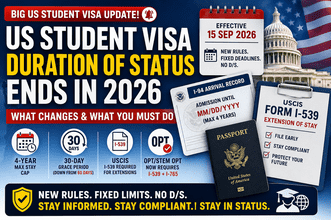
| Standard Admission Cap | Up to 4 years maximum per entry | Program end date on Form I-20 (whichever is shorter) |
| Stay Extension Protocol | Mandatory Form I-539 application | Required for PhD, medical, and multi-degree programs |
| SEVIS I-901 Base Fee | US$350 | Standard across all academic F-1 pathways |
| F-1 Visa Application Fee | US$185 | Paid directly to the U.S. Embassy/Consulate portal |
| Form I-765 OPT Base Fee | US$470 (Online filing) | US$520 (Paper/Mail-in filing option) |
| OPT Premium Processing Fee | US$1,780 | Optional inflation-adjusted add-on fee via Form I-907 |
| Post-Graduation Grace Window | Exactly 30 days to file or depart | Shortened from the legacy 60-day historical window |
| Biometric Screenings | Mandatory in-person appointment | Scheduled at a local USCIS Support Center |
| Security Screening Tiers | Enhanced background and social media vetting | Uniformly enforced globally across all entry ports |
Understanding the Fixed Admission Overhaul
The United States immigration architecture has introduced historic integrity controls to monitor nonimmigrant stays. The decades-old policy of letting international academic applicants remain indefinitely under an open-ended framework has been systematically rolled back. Your lawful presence now hinges on fixed end dates stamped directly onto your arrival documentation, making early administrative extensions vital.
Entity Relationship Snapshot
- The Department of Homeland Security (DHS) administers the transition away from Duration of Status (D/S).
- U.S. Citizenship and Immigration Services (USCIS) evaluates all Form I-765 OPT and Form I-539 extension filings.
- U.S. Customs and Border Protection (CBP) issues fixed-date expiration targets on your electronic Form I-94.
- The Student and Exchange Visitor Program (SEVP) monitors institutional compliance via the SEVIS tracking database.
The New Four-Stage US Student Visa Pipeline
Stage 1: SEVIS Activation
Gain formal admission to an SEVP-certified American college or university. Secure your physical Form I-20 from your school, pay the mandatory US$350 SEVIS I-901 fee online, and lock in your unique identification number.
Stage 2: Embassy Verification
File your DS-160 profile, pay the US$185 visa processing fee, and clear the expanded digital social media background checks. Attend your in-person embassy interview to secure the physical F-1 visa stamp.
Stage 3: Port of Entry Compliance
Pass through U.S. Customs and Border Protection at the border. Immediately log into the official CBP database to download your electronic Form I-94, noting the specific 4-year calendar expiration date rather than a flexible status notation.
Stage 4: Professional Work Transition
Submit your Form I-765 up to 90 days before your program concludes. Pay the base US$470 online fee, attend your mandatory fingerprinting biometrics appointment, and secure your physical Employment Authorization Document (EAD) within the compressed 30-day post-grad window.
Does my Form I-94 still show “D/S” (Duration of Status) under the new 2026 US visa rules?
No. U.S. Customs and Border Protection (CBP) assigns a fixed, specific expiration date on your electronic Form I-94 arrival record.
The historical open-ended “Duration of Status” (D/S) designation has been replaced. Border officials now limit your lawful entry period to the exact program end date printed on your Form I-20 or a maximum threshold of four years, whichever timeline is shorter. You must log into the official CBP portal immediately after arriving in the United States to verify and record this fixed expiration date.
Can a PhD student stay longer than 4 years in the US without filing a formal USCIS extension?
No. Doctoral candidates and long-term researchers must submit a formal Form I-539 Application to Extend Nonimmigrant Status to stay past the 4-year limit.
Because the automated SEVIS updates issued by university advisors no longer grant automatic legal status past the four-year mark, you cannot remain in the country simply by staying enrolled. If your doctoral degree or multi-degree track requires five to six years to finish, you must file a paid extension application directly with USCIS. Failing to submit this profile before your I-94 expiration date triggers immediate unlawful presence.
What is the exact filing fee for an F-1 OPT or STEM OPT extension application?
The base online filing fee for Form I-765 is US$470, while the optional Premium Processing upgrade costs US$1,780.
USCIS charges a standard fee of US$470 if you complete your application digitally through the online portal, or US$520 if you submit a traditional paper packet via a mail lockbox. If your employment start date is approaching rapidly and you need a fast decision, you can pay an additional US$1,780 to activate premium processing, which forces a decision within 30 business days.
How many days do I have after graduation to apply for OPT before losing my F-1 status?
You have exactly 30 days. The Department of Homeland Security restricts the post-completion application grace period to a strict 30-day filing window.
The historical 60-day post-graduation window has been cut in half. Your complete Form I-765 work application must be successfully filed with USCIS within 30 days of your official program completion date. If you miss this compressed deadline without changing your visa status or leaving the country, you fall out of status and face immediate deportation procedures.
Do I need to have a confirmed job offer before I apply for my post-completion OPT?
No. Eligible international graduates can apply for initial post-completion OPT without a pre-existing employment contract.
USCIS approves your Form I-765 work permit based strictly on your graduation status and institutional recommendation. You do not need to upload a corporate job offer to secure your card. However, once your physical EAD card arrives and your approved start date begins, you must secure a relevant position to avoid exceeding the permitted aggregate unemployment limit of 90 days.
What happens if I miss my mandatory USCIS biometrics appointment after filing for OPT?
Your work authorization application will face an immediate administrative denial under abandonment protocols.
USCIS enforces a strict fingerprint and photography requirement for all employment applicants at a local Application Support Center (ASC). Fingerprint waivers have been removed for student cohorts. You must monitor your online portal account closely for your ASC appointment notice and attend your designated session; missing this window causes your application to be rejected, and you will lose your filing fees.
Careers Help Desk Strategic Advice
- Audit Your Arrival Record Instantly: Do not drive away from the airport without logging into the CBP website on your mobile browser. If a border officer mistakenly stamps your passport with an incorrect date, your university advisor cannot fix it internally; you must report to a deferred inspection site immediately to correct the data error.
- File for Work Authorization at the 90-Day Mark: Because the post-graduation grace period is limited to 30 days, do not wait until finals week to prepare your paperwork. Submit your online Form I-765 exactly 90 days before your course ends to beat the summer processing backlogs.
- Budget for Combined Fee Thresholds: Securing your work permit requires separate outlays. Combine your base US$470 fee with your local travel budgets for your fingerprinting appointments, and set aside the optional US$1,780 premium fee if you have a corporate start date arriving quickly.
Related North American Resource Clusters
If you want to clear further application bottlenecks, utilize our upcoming curated resources:
- If you are considering options across the border: Look out for our upcoming Canada Study Permit Rules and Caps Hub (Coming Soon).
- If you want to secure funding before choosing a destination: Check back shortly for our comprehensive DAAD EPOS Scholarship Germany Guide (Coming Soon).
- If you want to explore graduate pathways in the Southern Hemisphere: Watch for our polished Australia Student Visa and 485 Age Limit Breakdown (Coming Soon) to secure your moving timeline.
Conclusion
The 2026 U.S. nonimmigrant updates prioritize strict time limits, faster filing schedules, and rigorous fingerprint tracking. While advanced degree candidates can secure extended stays, they must proactively manage their USCIS extensions to avoid illegal presence. Track your digital arrival profiles, complete your language and employment filings early, and work closely with your institutional advisors to secure your professional track in the United States.
Official Sources
- U.S. Department of Homeland Security (DHS) Regulation Portal
- U.S. Citizenship and Immigration Services (USCIS) Form I-765 Hub
- U.S. Customs and Border Protection (CBP) Form I-94 Portal
- SEVP SEVIS Fee Management Portal
Explore More Study & Research Opportunities in the United States
Now that you understand the latest US F-1 student visa rules, you may also be interested in these prestigious opportunities available in the United States. These guides explain eligibility, funding, deadlines, and the complete application process.
- Planning a graduate degree at Stanford University? Read our Knight-Hennessy Scholarship 2027 USA | Fully Funded Stanford Graduate Programs guide to learn how international students can receive full tuition, a living stipend, travel funding, relocation support, and leadership development.
- Looking for a world-class interdisciplinary research fellowship? Explore the Harvard Radcliffe Institute Fellowship 2027–2028 and discover how scholars, scientists, writers, journalists, and artists can receive an US$83,000 fellowship package to pursue independent research at Harvard University.
- Interested in launching an independent research career? Read our Harvard Rowland Fellowship 2027 in USA guide, which explains the prestigious fellowship offering a US$225,000 annual research budget, principal investigator independence, and laboratory support for outstanding early-career experimental scientists and engineers.
- Browse all United States opportunities on Careers Help Desk to discover the latest fully funded scholarships, fellowships, internships, research positions, and graduate programs available for international students.


0 Comments