The TOGAS Postdoctoral Fellowships 2027 at the University of Antwerp, Belgium, offer five international researchers a 60-month academic career development opportunity through the EU-funded MSCA Choose Europe for Science initiative. Selected fellows receive €4,187.94 in monthly gross remuneration and a separately listed €710 monthly mobility allowance during the first 36 months, alongside research funding, training and support for an independent academic career.
Applications are open to researchers of all nationalities who hold a relevant PhD, meet the maximum six-year research experience requirement (subject to permitted extensions), and satisfy the MSCA mobility rule for Belgium. Only five fellowships are available, one for each research theme. Applications close on 8 February 2027 at 17:00 CET. The programme offers a pre-tenure track career pathway, but does not guarantee permanent academic employment.
TOGAS Postdoctoral Fellowships 2027: Quick Overview
| Details | Information |
|---|---|
| Programme | Training for Opportunities and Growth in Academic Sustainability (TOGAS) |
| Host institution | University of Antwerp, Belgium |
| Funding initiative | MSCA Choose Europe for Science |
| Academic level | Postdoctoral research |
| Available positions | 5 |
| Fellowship duration | 60 months (36 + 24 months) |
| Phase 1 remuneration | €4,187.94/month gross |
| Mobility allowance | €710/month during Phase 1 |
| Research and training support | €700/month, supervisor-managed |
| Eligible nationalities | All nationalities |
| Applications open | 9 November 2026 |
| Application deadline | 8 February 2027, 17:00 CET |
| Expected starting dates | 1 September–1 November 2027 |
| Application method | Online |
TOGAS vs MSCA Postdoctoral Fellowships: TOGAS is a University of Antwerp recruitment programme co-funded through the MSCA Choose Europe for Science initiative. It is different from the European Commission’s standard MSCA Postdoctoral Fellowships scheme.
For TOGAS, applicants select one of five predefined research themes and submit directly through the university’s TOGAS application portal. The eligibility rules, remuneration structure and application deadline described here apply specifically to TOGAS. The programme is designed for early-career researchers who want to develop independent research projects and pursue longer-term academic careers.
What Does the TOGAS Fellowship Cover?
Unlike many shorter postdoctoral opportunities, TOGAS offers a 60-month appointment structured around two career development phases.
Phase 1: First 36 months
During the first three years, fellows receive:
- €4,187.94 monthly gross remuneration, subject to applicable social security deductions and other compulsory costs.
- €710 monthly mobility allowance to support personal relocation-related costs.
- Full social security coverage under the applicable Belgian arrangements.
- Research supervision, academic training and career development support.
- Access to research facilities and interdisciplinary collaboration opportunities.
The programme also specifies a minimum monthly remuneration cost of €6,700 under the MSCA funding framework. This figure includes employer costs, social security contributions, applicable deductions and the mobility allowance. It is not the fellow’s take-home salary.
Phase 1 appointments are made through yearly postdoctoral fellowship agreements, with positive annual assessments required for renewal.
Phase 2: Final 24 months
The University of Antwerp funds the second phase, which combines a 90% contractual postdoctoral researcher position with a 10% temporary academic staff appointment, subject to the specified appointment procedure.
The transition to Phase 2 involves additional appointment conditions. According to the official applicant guide, the 10% temporary academic staff component requires a successful application to the relevant vacancy at the end of Phase 1. The fellowship should therefore not be interpreted as an unconditional five-year employment guarantee or automatic appointment to an academic staff position.
Remuneration follows the applicable university salary scales and seniority. The €710 mobility allowance does not continue into Phase 2. TOGAS also allocates €700 per month for research and training activities, managed by the supervisor. This budget supports eligible expenses such as laboratory materials, equipment, academic training, conferences and project-related travel. It is not paid directly to fellows as an additional monthly salary or living allowance..
TOGAS uses a pre-tenure track model, but applicants should understand that this offers a pathway towards a long-term academic position, not a guaranteed permanent appointment.
Available Research Areas and Supervisors
Applicants must propose an original research project within one of five defined themes. Each theme has one available fellowship.
| Research theme | Supervisor |
|---|---|
| Catalytic methods for sustainable chemical transformations | Prof. Bert Maes |
| Plasma-based sustainable chemistry | Prof. Annemie Bogaerts |
| Co-governance for sustainable transitions: a systemic design perspective | Prof. Els Du Bois |
| (Adaptive) reuse for environmental changes and stakeholder-driven design | Prof. Sara Eloy |
| Molecular basis of disease and protein biochemistry | Prof. Ingrid De Meester |
The research opportunities cover sustainable organic synthesis, plasma-based CO₂ and methane conversion, circular product design, adaptive reuse of buildings, and molecular mechanisms underlying disease.
For example, researchers interested in chemical engineering, plasma reactor modelling or sustainable gas conversion may find Theme 2 particularly relevant. Researchers working on circular design and sustainability transitions should examine Themes 3 and 4.
Applicants should review the official research theme descriptions before deciding where their expertise fits.
Who Is Eligible for the TOGAS Postdoctoral Fellowships?
The University of Antwerp welcomes applicants from any country, but all candidates must satisfy the following conditions.
1. PhD qualification
You must hold a relevant doctoral degree by the application deadline. Applicants who have successfully and unconditionally defended their PhD before 8 February 2027 may also qualify even if their diploma has not yet been issued.
2. Maximum six years of research experience
Applicants must have obtained their first PhD no more than six years before the deadline, subject to permitted extensions.
Eligible extensions include maternity or paternity leave, compulsory national service, qualifying long-term sick leave and periods of professional experience outside research.
Can researchers with more than six years since their PhD apply?
Possibly. TOGAS allows extensions to the six-year eligibility period for qualifying career interruptions and non-research employment.
The official guide permits 18 months (548 days) of extension per child born after the PhD award for maternity leave, or the actual leave duration if longer. Paternity leave is counted according to the actual period taken. Compulsory national service, non-research professional experience and long-term sick leave exceeding 30 days may also qualify.
Applicants must declare relevant periods in the structured CV. Supporting evidence is not required with the initial application but may be requested during selection.
Researchers whose PhD dates fall outside the standard six-year window should check these provisions before assuming they are ineligible.
3. MSCA mobility requirement
You must not have resided or carried out your main activity, including employment or studies, in Belgium for more than 12 months during the 36 months immediately preceding 8 February 2027.
Certain periods, including qualifying short visits and compulsory national service, are excluded from this calculation.
4. Employment restriction
Applicants must not already hold permanent employment at the University of Antwerp.
5. Research alignment
Your proposed project must fit one of the five research themes and the programme’s sustainability orientation.
There is no nationality restriction. However, eligibility for international researchers depends on satisfying the doctoral, research experience and mobility requirements, not simply holding a PhD.
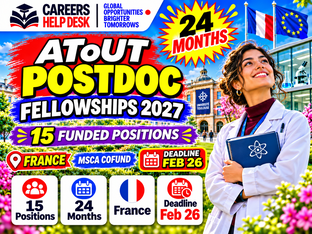
Exploring other postdoctoral opportunities in Europe? Researchers who do not meet the TOGAS mobility requirements, or whose work does not match its five research themes, can also explore the AToUT Postdoctoral Fellowship 2027 in France. This MSCA COFUND-supported programme offers 15 two-year research positions, with a published minimum gross salary of €3,393.58 per month. Its application deadline is 26 February 2027, and its eligibility conditions differ from TOGAS.
Required Application Documents
The application has two components.
Part A is completed through the online portal and includes personal information, a project summary, at least three keywords and details of three references who may be contacted before the interview.
Part B requires five documents:
- Structured CV: A narrative CV covering research achievements, teaching, mentoring, leadership and wider contributions.
- Research proposal: Your proposed objectives, methodology, feasibility, expected impact and fit with the host research environment.
- Motivation statement: Your academic career ambitions and reasons for pursuing a longer-term research career at Antwerp.
- Ethics self-assessment: Identification of relevant research ethics issues and proposed safeguards.
- PhD diploma or official confirmation: Including a certified English translation where necessary, or an acceptable institutional statement confirming successful unconditional defence.
All five documents must be submitted as PDFs, each no larger than 2 MB. Applicants must use the official templates and follow the prescribed page limits and file naming rules.
The university also requires applicants using generative AI to prepare their research proposals to disclose the tools used, their purpose and the relevant sections. Applicants remain responsible for the accuracy and integrity of their submissions.
Official templates are available on the TOGAS application documents page. The TOGAS structured CV is designed to assess more than publications alone. Applicants should also present relevant research contributions, teaching, mentoring, leadership and professional experience. Our academic CV writing guide explains how to organize these achievements clearly, with examples for research-focused applications. Follow the official TOGAS template rather than substituting a general CV format.
Your TOGAS motivation statement should explain why the fellowship fits your long-term academic career plans, including your interest in developing an independent research profile at the University of Antwerp. For help organizing your experience and future goals, see our motivation letter writing guide. Its examples are intended for scholarships, so adapt the guidance to TOGAS’s specific postdoctoral career-development requirements.
What should your TOGAS research proposal demonstrate?
The proposal must explain your research objectives, methodology, feasibility, expected impact and integration with the University of Antwerp’s research environment.
A particularly important requirement is two-way knowledge transfer: what expertise you will bring to the host group and what research capabilities, facilities or collaborations the host can contribute to your project.
The university also encourages applicants to consider international, intersectoral or interdisciplinary secondments where they would meaningfully support the proposed research. These are optional, not mandatory.
Use the official TOGAS research proposal template and demonstrate how your proposed work fits within the five-year fellowship. Avoid adding collaborations or activities that cannot realistically be delivered.
Applicants who need help developing their research questions, methodology and project timeline can consult our guide to writing a PhD research proposal. Although the examples focus on doctoral research, the guidance on feasibility, identifying a research gap and explaining methods is also useful for postdoctoral proposals. TOGAS applicants must still follow the programme’s own template and evaluation criteria.
How Are TOGAS Fellows Selected?
The programme follows a five-stage selection process involving eligibility screening, independent peer review, pre-selection, interviews and appointment.
The official evaluation framework assigns the following weights:
| Evaluation criterion | Weight |
|---|---|
| Applicant qualifications, potential and motivation | 40% |
| Research project quality | 30% |
| Integration with the academic environment | 30% |
Reviewers consider research achievements, teaching and leadership potential, scientific originality, methodological feasibility and the proposed project’s contribution to the host environment.
Each criterion is scored from 0 to 5. Applicants must meet a minimum score of 3 in each criterion and an overall threshold of 10 out of 15 before weighting. Applications failing these thresholds with at least two peer reviewers do not advance to pre-selection.
Up to five candidates per research theme will be invited to an online interview in June 2027, with additional candidates potentially placed on reserve lists.
Final selection considers the research proposal, academic potential and motivation to develop an independent career at the University of Antwerp.
Careers Help Desk Counter Angle: Your Research Fit Matters as Much as Your CV
The TOGAS evaluation framework assigns 30% of the score to integration with the academic environment. This is particularly important because applicants are competing for a single position within their chosen research theme.
A strong publication record alone cannot establish that your proposed five-year project is feasible within the selected research group.
Before drafting your proposal, examine the host group’s facilities, current expertise and research priorities. Identify what you can contribute and which capabilities the university can provide. Explain this two-way knowledge transfer explicitly in your application.
Applicants may contact the relevant supervisor for scientific advice, infrastructure information and clarification of research expertise. However, supervisors cannot participate in drafting your proposal and have no role in the selection process.
This distinction matters: contacting a supervisor can help establish feasibility, but it does not provide a selection advantage or replace independent proposal development. If you need to clarify laboratory facilities or the research group’s expertise, keep your message specific and focused on the questions TOGAS permits. Our guide to emailing a professor about research opportunities provides practical examples of concise academic inquiries. However, TOGAS supervisors cannot help draft your proposal, and contacting them does not influence the independent selection process.
Another consideration is Dutch language proficiency. Although applications are submitted in English, the university identifies Dutch language development as important for potential longer-term academic appointments involving teaching responsibilities. Candidates pursuing an academic career in Belgium should factor this into their career plans.
How to Apply for the TOGAS Fellowships 2027
Applications must be submitted directly through the University of Antwerp’s online portal.
Step 1: Read the official Guide for Applicants and verify your eligibility.
Step 2: Select one research theme and review the associated supervisor and research environment.
Research themes for TOGAS MSCA Postdotcoral Science fellowship in Belgium
Step 3: Download and complete the required application templates (Given below click on each in the list to download).
- Structured CV template
- Research proposal template
- Motivation statement template
- Ethics self-assessment form
Step 4: Prepare the project summary, keywords and three reference contacts.
Step 5: Submit the complete application before 8 February 2027 at 17:00 CET and retain the email confirmation. Upload the five mandatory PDF documents, following the specified file sizes and naming conventions.
Apply through the TOGAS Application Portal for EU-Funded Postdoc Positions
No advance registration is required to access the application portal.
Important Dates for Applicants
| Stage | Date |
|---|---|
| Applications open | 9 November 2026, 09:00 CET |
| Applications close | 8 February 2027, 17:00 CET |
| Eligibility screening | February 2027 |
| Independent peer review | March–mid-May 2027 |
| Pre-selection | Mid–end May 2027 |
| Online interviews | June 2027 |
| Results announced | July 2027 |
| Fellowships begin | September–November 2027 |
Applicants outside Europe should convert the submission deadline into their local time zone and avoid waiting until the final day.
Ready to Start Research Career in Belgium
The TOGAS Postdoctoral Fellowships 2027 offer five years of research employment and structured academic development at the University of Antwerp. For eligible international researchers, the most important decisions are whether they satisfy the MSCA mobility rule and whether their proposed research can make a convincing contribution to one of the five host environments. The application deadline is 8 February 2027 at 17:00 CET. Applicants should review the official guide, prepare their proposal independently and complete their submission well before the deadline. For programme-specific questions, contact the University of Antwerp TOGAS helpdesk at togas@uantwerpen.be.
Official Source: TOGAS Call for Talented Postdoctoral Researchers
Frequently Asked Questions (FAQs)
1. Can international researchers apply for TOGAS 2027?
Yes. The fellowship is open to applicants of all nationalities, including researchers outside the European Union. All applicants must meet the PhD experience, mobility and research theme requirements.
2. Can I apply if I have not yet received my PhD diploma?
Yes, provided you successfully and unconditionally defend your doctoral thesis before 8 February 2027. You must supply an acceptable official statement from your doctoral institution if your degree has not yet been awarded.
3. How much does the TOGAS fellowship pay?
During Phase 1, fellows receive €4,187.94 in monthly gross remuneration and a €710 monthly mobility allowance. Phase 2 remuneration follows the applicable university salary scales. Actual take-home pay depends on the relevant deductions and employment arrangements.
4. Is IELTS required for the TOGAS fellowship?
The published application requirements specify that applications and supporting documents must be in English, but do not list a mandatory IELTS or TOEFL score. Applicants should consult the official guide and contact the TOGAS helpdesk if they need clarification about language requirements.
5. Does TOGAS guarantee a permanent academic position?
No. The programme offers a structured pre-tenure track career development pathway with a long-term academic perspective. A permanent position beyond the fellowship is not guaranteed.
6. Can I submit applications for multiple research themes?
Only one proposal per applicant is permitted. If multiple applications are submitted, the university considers only the latest submission. Candidates should therefore select the research theme that best matches their expertise and proposed project.
Stay connected with Careers Help Desk for the latest international fellowships, scholarships, research opportunities and jobs abroad to empower your future!

0 Comments