Canada’s updated international student rules created major changes for study permits, Provincial Attestation Letters (PALs), and Post-Graduation Work Permit (PGWP) eligibility. This guide explains the official IRCC requirements using current 2026 policies so you can understand exactly what applies to your situation. Start with the quick-reference table below, then find detailed answers to the most frequently searched questions.
Canada Study Permit & PGWP Rules at a Glance
| Requirement | 2026 Rule |
| National Study Permit Cap | Applies primarily to undergraduate, diploma, and certificate programs |
| Master’s & PhD PAL Requirement | Not required at eligible public DLIs |
| Proof of Funds (Outside Quebec) | Minimum CAD $22,895 living expenses + first-year tuition + travel costs |
| PhD Processing | Eligible online applications from outside Canada may receive decisions in about 14 calendar days |
| Degree Graduate PGWP Language Requirement | CLB 7 in Reading, Writing, Listening, and Speaking |
| Diploma/Certificate PGWP Language Requirement | CLB 5 in all four language abilities |
| Degree Graduate Field Restriction | None |
| Diploma/Certificate Field Restriction | Program must match an approved IRCC labor shortage CIP list |
| PGWP Application Deadline | Apply within 180 days after receiving final marks |
| Flagpoling for PGWP | Not permitted |
How does Canada’s new international student cap work?
Immigration, Refugees and Citizenship Canada (IRCC) enforces a strict national application intake cap to manage international student numbers. This cap targets specific undergraduate, diploma, and certificate streams across Canadian provinces. However, the system deliberately creates separate priority pathways for advanced degree applicants, granting them absolute exemption from provincial allocations.
Do Master’s and PhD students need a Provincial Attestation Letter (PAL) to study in Canada?
No. Master’s and Doctoral students do not require a Provincial or Territorial Attestation Letter (PAL/TAL) under the 2026 exemption framework.
This policy carve-out allows graduate applicants to bypass provincial allocations completely. IRCC exempts both Master’s degree students and Doctoral (PhD) researchers who are enrolling at eligible public Designated Learning Institutions (DLIs). If you are pursuing an undergraduate degree, a college certificate, or a career diploma, your institution must secure a PAL before you submit your study permit application.
What is the exact amount required for proof of funds for a Canadian study permit outside Quebec?
You must show at least CAD $22,895 for living expenses if you are a single applicant studying outside Quebec.
This baseline index matches current cost-of-living metrics. Applicants must demonstrate this total financial allocation upfront, completely excluding separate costs for first-year tuition fees and return airfare. IRCC accepts official financial coverage via a Guaranteed Investment Certificate (GIC), verified bank statements from the past four months, or an approved educational loan sanction letter. Your financial evidence must clearly demonstrate that the required funds are readily available.
Can I get a 3-year Post-Graduation Work Permit (PGWP) if my Master’s program is only 1 year or 16 months long?
Yes. Eligible Master’s graduates may receive a three-year PGWP even if their Master’s program lasted only one year or approximately 16 months.
This rule represents one of the most significant benefits available to Master’s graduates. To qualify, you must still satisfy every other PGWP requirement, including:
- Graduating from an eligible DLI
- Completing an eligible Master’s program
- Applying within 180 days after receiving your final marks
- Maintaining valid temporary resident status when required
- Meeting the applicable language requirement
The shorter duration of your Master’s program does not reduce your potential PGWP validity if you qualify under this policy.
Do university Bachelor’s or Master’s graduates have to choose a specific “shortage field” to qualify for a PGWP?
No. Bachelor’s, Master’s, and PhD graduates bypass the field-of-study restrictions entirely.
IRCC applies field-of-study restrictions only to non-degree programs, including college diplomas and certificate courses. These college graduates must complete a program that matches an approved labor shortage field identified through official Classification of Instructional Programs (CIP) codes. University degree graduates do not need to study in one of these designated shortage occupations. This means eligible graduates from Bachelor’s, Master’s, and Doctoral programs can qualify for a PGWP regardless of their academic discipline, provided they meet all other eligibility conditions.
What happens if my language test score drops below CLB 7 in just one section for a degree-level PGWP?
Your PGWP application will face immediate refusal if you fail to achieve CLB 7 in even one of the four language abilities.
IRCC requires university degree graduates to achieve a minimum of CLB 7 individually in:
- Reading
- Writing
- Listening
- Speaking
A score below CLB 7 in only one skill, such as writing, does not satisfy the requirement. You must also ensure that:
- Your language test is approved by IRCC.
- You took the test in person.
- Your results are less than two years old when you submit your PGWP application.
For diploma and certificate graduates, the minimum requirement is CLB 5 in all four abilities, not an average score.
Can I apply for a PGWP at a Canadian land border (flagpoling) to get it faster?
No. IRCC strictly prohibits the practice of flagpoling for Post-Graduation Work Permit applications.
You must submit your PGWP application through the approved online application process. Attempting to leave Canada briefly and re-enter for immediate work permit processing is no longer an available option for PGWP applicants. To avoid delays, you should:
- Prepare your language test before graduation.
- Collect your completion letter and final transcript promptly.
- Submit your online PGWP application within 180 days after receiving your final marks.
- Maintain your legal temporary resident status throughout the application process.
Canada Study Permit and PGWP Timeline
Stage 1: Admission
Apply to an eligible public DLI. Undergraduate, diploma, and certificate students wait for their PAL. Master’s and PhD students proceed without a PAL if exempt.
Stage 2: Financial Preparation
Prepare evidence showing:
- CAD $22,895 minimum living expenses (outside Quebec)
- First-year tuition
- Travel costs
You may use a GIC or other acceptable financial documentation.
Stage 3: Study Permit Application
Submit your study permit application online. Eligible PhD applicants applying from outside Canada, including accompanying spouses and dependent children, may benefit from priority processing with decisions issued in as little as 14 calendar days.
Stage 4: Graduation and PGWP
Before graduating:
- Complete an approved language test.
- Confirm your language score meets the required CLB level.
- Submit your online PGWP application within 180 days after receiving your final academic results.
Careers Help Desk Strategic Advice
- If you are applying for a Master’s or PhD: Take advantage of the PAL exemption by preparing your financial documents and admission package early. Removing the PAL step simplifies your application timeline significantly.
- If you are pursuing a diploma or certificate: Before accepting an offer, verify that your program appears on the applicable IRCC labor shortage field list. Choosing a non-eligible program prevents PGWP eligibility after graduation.
- Schedule your language test early: Many graduates delay their language test until after graduation. This creates unnecessary risk. Complete your approved English or French test before finishing your studies so your PGWP application is ready as soon as your final marks become available.
Related Canada Guides
If you want to clear further application bottlenecks, utilize our curated resources:
- If you need to verify your full financial documents checklist: Look out for our upcoming Canada Study Permit Proof of Funds Guide (Coming Soon).
- If you are comparing Master’s and PhD immigration tracks: Check back shortly for our specialized Canada Graduate Study Permit Guide (Coming Soon).
- If you are preparing for graduation work options: Watch for our comprehensive Canada PGWP Eligibility Guide (Coming Soon) to secure your post-grad timeline.
Conclusion
Canada’s 2026 reforms create two very different pathways for international students. Master’s and PhD applicants benefit from PAL exemptions, expedited processing, and flexible PGWP eligibility, while diploma and certificate students must carefully satisfy both PAL and field-of-study requirements. Understanding these rules before you apply helps you avoid unnecessary delays and protects your eligibility for a Canadian work permit after graduation.
Official Sources
- Immigration, Refugees and Citizenship Canada (IRCC) Official Portal
- IRCC Study Permit Policy Guidance
- IRCC Post-Graduation Work Permit Program Details
Scholarship Opportunities in Canada
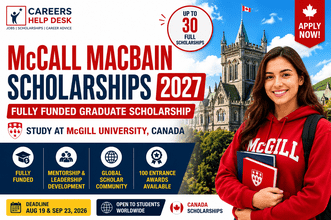
- If you are looking for the fully funded scholarship to study in Canada, consider McCall MacBain Scholarships 2027 in Canada (Fully Funded) | Study at McGill University which provides scholarship for bachelors, Master and PhD Studies with monthly stipends.
- If you are looking for research opportunities in Canada, consider Canada Impact+ Research Training Awards 2026 (Fully Funded PhD & Postdoc in Canada) which provides the competetive salary, research grants to start the research careers in Canada.
Stay connected with Careers Help Desk for the latest international fellowships, scholarships, and research opportunities to empower your future!


1 Comment
US Student Visa D/S Rule 2026: 4-Year Limit & I-539 · July 20, 2026 at 2:59 PM
[…] If you want direct permanent residency pathways following graduation: Explore our guide on Canada Post-Graduation Work Permit (PGWP) Changes. […]