The EMABG Erasmus Mundus Scholarship 2027 offers international students a fully funded, two-year Master’s degree in Animal Biodiversity and Genomics at two European universities. Selected students receive €1,400 per month for up to 24 months, worth a maximum of €33,600, with tuition fees and insurance covered. Applications are open to students of all nationalities who hold a relevant bachelor’s degree in animal science, biology, agriculture or a related field and meet the programme’s English-language requirements. Approximately 15 scholarships are available for the 2027 intake, and the application deadline is 15 January 2027.
The programme is particularly suitable for students interested in animal genetics, biodiversity conservation, sustainable breeding, bioinformatics and genomic research. Applicants study at two of six European partner universities, choosing pathways that reflect their academic background and intended specialisation.
EMABG Erasmus Mundus Scholarship 2027: Quick Overview
| Detail | Information |
|---|---|
| Programme | European Master in Animal Biodiversity and Genomics (EMABG) |
| Scholarship | Erasmus Mundus Joint Master (EMJM) |
| Study level | Master’s degree |
| Duration | 2 years (120 ECTS) |
| Study location | Two European consortium universities |
| Teaching language | English |
| Monthly scholarship | €1,400 |
| Maximum scholarship payments | €33,600 over 24 months |
| Tuition and insurance | Covered for EMJM scholarship recipients |
| Scholarships available | Approximately 15 per intake |
| Eligible nationalities | All nationalities, subject to admission and scholarship conditions |
| Applications opened | 15 September 2026 |
| Scholarship deadline | 15 January 2027 |
| Programme start | August 2027, beginning with the Welcome Course |
What Is the European Master in Animal Biodiversity and Genomics?
The European Master in Animal Biodiversity and Genomics (EMABG) is a joint European Master’s programme combining animal genetics, biodiversity conservation, breeding sciences and modern genomic technologies.
Students study at two of the consortium’s six universities, gaining experience in different academic and research environments.
The programme addresses challenges such as conserving endangered animal species, maintaining genetic diversity, improving sustainable livestock production and applying genomic tools to animal breeding.
Its curriculum also prepares graduates for further doctoral research and careers in animal genetics, conservation science, agricultural research and related industries.
Universities and Study Areas
The EMABG consortium includes six European universities:
- Norwegian University of Life Sciences (NMBU), Norway
- Swedish University of Agricultural Sciences (SLU), Sweden
- Wageningen University & Research (WUR), Netherlands
- BOKU University, Austria
- University of Göttingen, Germany
- AgroParisTech, France
Students follow an approved study track involving two partner institutions.
The programme offers five specialisation areas:
- Conservation genomics for rare and endangered breeds and species.
- Designing and implementing breeding programmes for small populations.
- Bioinformatics applied to biodiversity and genomics.
- One Health: health and welfare in humans and animals.
- Understanding biodiversity through integrative biology.
Applicants should examine the available university combinations before choosing their preferred study tracks. Their previous coursework and research interests should support the specialisations they select.
Students interested in agricultural sciences but more focused on crop protection than animal genetics may also explore the PlantHealth Erasmus Mundus Scholarship 2027. This two-year European Master’s programme offers €1,400 per month to selected scholarship recipients, with a scholarship application deadline of 31 December 2026.
EMABG Scholarship Benefits: What Does the Funding Cover?
Successful EMJM scholarship recipients receive €1,400 monthly for up to 24 months. The scholarship is intended to cover living and mobility-related expenses, including accommodation, food, travel and visa costs.
Tuition fees and insurance are covered separately by the programme.
However, applicants should understand several financial conditions before accepting an offer.
First, the scholarship is not an advance payment. Students must initially finance their journey to the first university or Welcome Course location. Scholarship payments begin after arrival and are transferred to a European bank account.
Second, students must cover their own accommodation expenses during the Welcome Course, Summer School and Graduation Event, using their available funds.
Third, the programme does not pay subsistence support for periods spent in the student’s country of residence at the time of application.
Finally, applicants who have already received an Erasmus Mundus Joint Master scholarship are not eligible for another EMJM scholarship under the programme’s published rules.
These conditions matter particularly for students who cannot easily finance international travel or initial accommodation before their first scholarship payment.
Additional support for students with disabilities
EMABG has additional EU-funded support for eligible students with long-term physical, mental, intellectual or sensory impairments. Depending on individual needs and eligibility, funding may help cover assistance, adapted study arrangements or additional travel and transportation costs.
This support is available to eligible scholarship recipients and self-funded students.
Applicants requesting this assistance must include a statement explaining their needs and supporting documentation from a qualified professional in their online application.
What if you do not receive an EMABG scholarship?
Applicants who are not awarded an Erasmus Mundus scholarship may still be considered for self-funded admission or participate with third-party funding.
The programme publishes the following annual participation costs:
| Student category or study track | Annual participation cost |
|---|---|
| Students from EU Member States or associated Programme Countries | €4,500 |
| Non-associated third-country students: NMBU–BOKU, NMBU–UGOE or NMBU–APT | €10,000 |
| Non-associated third-country students: NMBU–SLU or NMBU–WUR | €19,000 |
These are programme participation costs, not the total cost of living. Scholarship recipients have their participation costs covered. Self-funded applicants should review the official EMABG costs before selecting a study track or accepting an admission offer.
Who Is Eligible for the EMABG Erasmus Mundus Scholarship?
Applicants must hold an academic Bachelor of Science degree of at least 180 ECTS in animal science or demonstrate a suitable background through another relevant bachelor’s programme.
Applicants from related disciplines should have knowledge in subjects such as:
- Mathematics, biostatistics or bioinformatics
- Zoology, anatomy or physiology of farm animals
- Animal biodiversity and breeding
- Genetics and genomics
- Agricultural sciences and animal production
Students who already hold a Master’s degree can also apply. However, the University of Göttingen cannot accept applicants who already possess an MSc in a similar field.
Final-year bachelor’s students may apply conditionally. According to the programme FAQ, non-EU applicants must graduate by 15 March, while EU applicants must graduate by 1 July. They must provide an official university letter confirming their expected completion date.
English Language Requirements
EMABG requires proof of English proficiency unless an applicant qualifies for an officially recognised exemption.
| Accepted test | Minimum requirement |
|---|---|
| TOEFL iBT | 92 overall, with at least 23 in Speaking |
| Academic IELTS | 7.0 overall, with at least 6.5 in Speaking |
| Cambridge C1 Advanced | Score 180–210, Grade C |
| Cambridge C2 Proficiency | Score 180–230 or Grade C |
English certificates must be no more than two years old at the application deadline.
The programme does not accept IELTS Online, IELTS One Skill Retake, paper-based TOEFL or TOEFL ITP.
Exemptions may apply to qualifying degrees completed entirely in English, on campus, in Australia, Ireland, Canada (excluding universities in Quebec), New Zealand, the United Kingdom or the United States. Additional conditions apply to double-degree programmes.
An English-medium degree does not automatically exempt applicants from providing a language test. EMABG accepts the published degree-based exemptions only under the specified conditions.
However, applicants from African countries should also check the programme’s separate country-specific guidance. For certain countries and study tracks, a secondary-school certificate or bachelor’s diploma may be accepted as English-language evidence. Eligibility depends on the applicable country and university requirements, and applicants should not assume that this applies across all EMABG study tracks.
The consortium reserves the right to request an English proficiency test from any applicant. Check the official admission requirements before submitting your application.
Required Documents for the 2027 Application
Applicants must submit their documents through the official EMABG application database.
The required materials include:
- Bachelor’s degree certificate, and Master’s certificate if applicable.
- Complete academic transcripts, including grading information.
- Passport identification page.
- Certificate of current residence.
- Curriculum vitae, preferably in Europass format.
- Recent personal photograph.
- Accepted English-language certificate or applicable exemption documentation.
- Letter explaining three preferred study tracks.
- Two recommendation letters from professors or employers.
- A personal motivation video lasting one to two minutes.
The motivation video must be in MP4 format, no larger than 50 MB, and named using only the applicant’s application number.
Academic certificates and transcripts must be issued, dated, signed and stamped by the relevant university. Documents not written in English require translations.
Applicants from China, Mongolia and Vietnam must also provide the applicable APS certificate and send it to the programme office before the deadline.
The certificate of residence must have been issued within the 12 months preceding the scholarship application deadline.
Applicants should also distinguish the study-track preference letter from the motivation video. The letter explains why the selected university combinations suit their academic interests; the video presents their personal motivation for joining EMABG.
EMABG does not require a conventional scholarship motivation letter. Instead, applicants submit a study-track preference letter and a separate motivation video. If you are unfamiliar with writing about programme fit and academic motivation, our guide on how to write a scholarship motivation letter provides examples and preparation tips. Follow EMABG’s specific instructions rather than submitting a general motivation letter.
How Are EMABG Scholarship Applicants Selected?
EMABG publishes a weighted selection system, allowing applicants to understand how their applications will be evaluated.
| Selection criterion | Weight |
|---|---|
| Academic excellence (grades and GPA) | 20% |
| Academic background relevant to EMABG | 30% |
| Personal motivation video | 20% |
| Curriculum vitae | 20% |
| Recommendation letters | 10% |
| Total | 100% |
Academic performance and subject relevance together account for half of the final assessment.
The selection committee also considers relevant internships, research activities and experience demonstrated through the CV. Applicants are assessed in relation to their educational and career stage, so recent bachelor’s graduates are not expected to have the same professional experience as established graduates.
The committee ranks eligible applicants using weighted scores. Academic excellence is used to break ties. The programme also seeks geographical and gender balance and normally selects no more than two candidates from one country.
EMABG does not conduct selection interviews. The motivation video therefore provides an important opportunity to communicate your personal interests and experience directly to the committee.
According to the official selection timeline, results are expected in early March 2027, followed by scholarship verification and admission documentation in April.
What should you include in the EMABG motivation video?
The motivation video accounts for 20% of the selection score, so its content deserves careful preparation.
In one to two minutes, explain what led you to become interested in animal biodiversity or genomics. Use a specific experience, such as a university project, laboratory exercise, research internship or conservation activity, to demonstrate your interest.
Then explain how the EMABG programme connects to what you want to study or do professionally.
Avoid simply repeating information from the programme website. The selection committee explicitly asks for personal motivation, based on your own interests and experience, rather than generic or AI-generated statements.
Keep the video within the required two-minute limit and follow the specified MP4 format and 50 MB file-size restriction.
Careers Help Desk Counter Angle: Academic Relevance Matters More Than Many Applicants Realise
One particularly important detail in EMABG’s selection system is that academic subject relevance carries 30% of the assessment, compared with 20% for grades.
This means applicants should examine more than their overall GPA when deciding whether to apply.
For example, a biology graduate who has studied population genetics, molecular biology, statistics and biodiversity conservation may have a relevant academic foundation, even without a degree specifically titled Animal Science.
However, applicants must still satisfy the programme’s admission requirements. Relevant coursework does not automatically guarantee eligibility.
Before applying, review your transcripts and identify courses that demonstrate the required scientific background. Use your CV and motivation video to explain relevant research projects, laboratory work, internships or conservation activities.
The strongest preparation is to connect your actual academic experience with the programme’s published learning areas rather than rely on general statements about your interest in studying in Europe.
If you find it difficult to explain how your academic background connects to your future goals, our guide on writing a statement of purpose for master’s applications explains how to organise those ideas using relevant academic and research experiences. EMABG does not require a separate SOP, but this approach can help you prepare the content of your motivation video.
How to Apply for the EMABG Erasmus Mundus Scholarship 2027
Applications are submitted online through the official EMABG application system.
Step 1: Visit the official EMABG application procedure and review the admission requirements and confirm that your qualifications and English certificate meet the conditions.
EMABG Erasmus Mundus Scholarship Application Requirements
Step 2: Choose three preferred study tracks based on your academic background and interests.
Step 3: Prepare the required documents, including signed academic records, recommendation letters and your study-track preference letter.
Step 4: Record your one- to two-minute motivation video and save it in the required format.
Stsep 5: Upload all required materials and submit your complete application before 15 January 2027.
Apply Here for EMABG Erasmus Mundus Scholarship 2027
The programme considers applications for both Master’s admission and Erasmus Mundus scholarship funding through its application process.
Applicants who do not receive a scholarship may still be considered for admission if they can arrange self-funding or third-party financial support.
The official application page also lists separate deadlines for self-paying students: 15 February for non-EU applicants and 15 April for EU applicants. Self-paying candidates should contact the central office early because the programme requires documents to reach the consortium at least three weeks before the relevant university-system deadline.
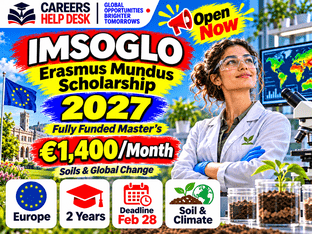
Applicants comparing funded European Master’s programmes may also consider the IMSOGLO Erasmus Mundus Scholarship 2027. It focuses on soils and global change, offers €1,400 per month for up to 24 months to selected scholars, and accepts scholarship applications until 28 February 2027. Its academic eligibility requirements differ from EMABG, so check your suitability before applying.
Ready to Apply for Eramus Mundus Scholarship 2027
The EMABG Erasmus Mundus Scholarship 2027 provides an opportunity for students interested in animal genetics, biodiversity conservation and genomic research to complete a joint European Master’s degree with substantial financial support. Applicants should pay particular attention to academic subject relevance, English-language requirements, study-track selection and the mandatory motivation video. With approximately 15 scholarships available, preparing a complete and well-supported application before 15 January 2027 is essential.
Official Source: EMABG Erasmus Mundus Joint Master Scholarship 2027 Call for Applications
Frequently Asked Questions
1. Is the EMABG Erasmus Mundus Scholarship 2027 fully funded?
Yes. Selected EMJM scholarship recipients receive €1,400 monthly for 24 months, while tuition fees and insurance are covered. Students must still manage their living and travel expenses within the scholarship allowance and arrange initial travel funding before payments begin.
2. Can students from Pakistan, India, Bangladesh, Nigeria and other non-EU countries apply?
Yes. EMABG accepts applicants from all nationalities who satisfy its admission requirements. Nationality does not automatically guarantee an English-language exemption, however, and applicants must follow the relevant language rules.
3. Can I apply without IELTS?
Yes, if you qualify for an accepted alternative test or an official exemption. A degree taught in English outside the programme’s recognised exemption conditions is not sufficient by itself. Applicants should also check the special country-specific guidance where applicable.
4. Can final-year bachelor’s students apply?
Yes. The programme allows conditional applications from final-year students, provided they submit an official university confirmation and complete their degree by the applicable deadline: 15 March for non-EU students or 1 July for EU students.
5. How many EMABG Erasmus Mundus scholarships are available?
The programme indicates approximately 15 scholarships per intake. Selection is competitive, and the committee normally limits the number of selected candidates from an individual country to two.
6. What happens if I am admitted but do not receive a scholarship?
You may be able to join as a self-funded or third-party-funded student. Participation costs vary by country category and study track, so check the official EMABG costs page before accepting an unfunded place.
Stay connected with Careers Help Desk for the latest international fellowships, scholarships, research opportunities and jobs abroad to empower your future!



0 Comments