The DENSYS 2.0 Erasmus Mundus Scholarship 2027–2029 offers international students the opportunity to pursue a two-year master’s degree in Decentralised Smart Energy Systems across European universities. Selected Erasmus Mundus scholarship recipients receive €1,400 per month for 24 months, with programme participation costs fully covered. Applications are open to students worldwide with relevant bachelor’s degrees in engineering, science, or related technical fields. The programme is particularly relevant to applicants interested in renewable energy, hydrogen technologies, energy storage, smart grids, and sustainable energy systems.
The application deadline is 27 January 2027 at 6:00 PM Central European Time (CET). Applicants must meet the academic and English language requirements and submit a complete application, including two recommendation letters uploaded by their referees, before the deadline.
DENSYS 2.0 Scholarship 2027: Quick Overview
| Detail | Information |
|---|---|
| Programme | DENSYS 2.0 Erasmus Mundus Joint Master |
| Academic intake | 2027–2029 |
| Study level | Master’s degree |
| Duration | 2 years (120 ECTS) |
| Countries | France, Sweden, Italy, Spain |
| Scholarship | €1,400 per month |
| Total monthly allowance | €33,600 over 24 months |
| Tuition and participation costs | Fully covered for EMJM scholarship holders |
| Eligible nationalities | All nationalities |
| Application opens | 12 October 2026 |
| Application deadline | 27 January 2027 |
| Application status | Open |
| Coordinating university | Université de Lorraine, France |
The scholarship is awarded competitively. Admission to DENSYS does not automatically guarantee Erasmus Mundus funding.
What Is the DENSYS 2.0 Erasmus Mundus Programme?
DENSYS stands for Decentralised Smart ENergy SYStems. It is a 120-ECTS Erasmus Mundus Joint Master’s programme designed to train engineers and researchers in the design, optimisation, management, and operation of decentralised energy systems.
The programme brings together four European universities:
- Université de Lorraine, France: Microgrids, hydrogen, and chemical energy carriers.
- KTH Royal Institute of Technology, Sweden: Renewable energy integration and large-scale energy systems.
- Politecnico di Torino, Italy: Power-to-X technologies and energy conversion.
- Universitat Politècnica de Catalunya, Spain: Thermal energy engineering.
Students begin their studies in Nancy, France, before moving to another partner university for their chosen specialisation.
The programme also includes applied projects, industry engagement, summer schools, and a master’s thesis or internship. Graduates receive two degrees: one from Université de Lorraine and another from the university responsible for their specialisation.
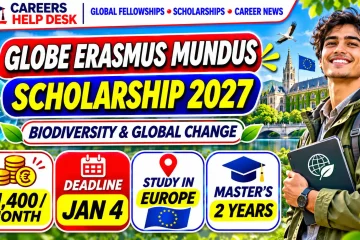
Applicants whose interests are closer to climate change, biodiversity, and environmental management than energy systems engineering may also explore the GLOBE Erasmus Mundus Scholarship 2027–2029. It offers competitive Erasmus Mundus funding, with applications closing on 4 January 2027.
DENSYS Erasmus Mundus Scholarship Benefits
The Erasmus Mundus Joint Masters scholarship provides two main financial benefits.
1. Monthly allowance of €1,400
Successful scholarship recipients receive €1,400 per month throughout the two-year programme, equivalent to €33,600 over 24 months.
This allowance supports students with living expenses, accommodation, travel, and other personal costs.
2. Full coverage of participation costs
The European Union covers the programme’s participation costs for Erasmus Mundus scholarship holders. These costs include institutional tuition fees, health and accident insurance, laboratory activities, excursions, academic visits, summer schools, and the immersive week at the University of Liège in Belgium.
Travel, housing, and living expenses are not separately included in participation costs. Students should budget for these using their monthly allowance and any other available personal resources. Before accepting any scholarship offer, check which expenses are included and whether you will need additional personal funds. Our guide on how to find fully funded scholarships abroad explains how to compare tuition coverage, living allowances, travel support, and other funding conditions.
Is a Separate Erasmus Mundus Scholarship Application Required?
No, DENSYS considers applicants for programme admission and financial support through its application and selection process. The Admission Board may offer an Erasmus Mundus scholarship, reduced participation costs, or self-funded admission.
Applicants should complete the financial support information requested in the official application system. Meeting the admission requirements does not guarantee an Erasmus Mundus scholarship, and a partial fee reduction does not include the €1,400 monthly allowance.
What If You Do Not Receive an Erasmus Mundus Scholarship?
DENSYS also offers limited reductions in participation costs and self-funded admission.
Students receiving a partial fee reduction remain responsible for the remaining participation costs and their personal expenses. The amount depends on citizenship and the selected specialisation track.
The programme advises students not to depend on part-time employment, particularly during the first year in France, because of the demanding academic schedule.
Alternative Funding: France Excellence Eiffel Scholarship
DENSYS also provides a separate application route for the France Excellence Eiffel Scholarship. The programme requires candidates interested in this route to create a DENSYS application account and email the specified documents to the consortium by 27 November 2026 at 6:00 PM, according to its published instructions.
This is a separate funding procedure from the Erasmus Mundus scholarship selection. Applicants should check their eligibility and the required documents on the official DENSYS application page. The Eiffel scholarship has different benefits and selection conditions, so the two funding packages should not be treated as interchangeable.
Who Is Eligible for the DENSYS 2.0 Scholarship?
Applicants from any country can apply, provided they meet the academic and language requirements.
Academic qualifications
Applicants need a bachelor’s degree or equivalent qualification from an internationally recognised university.
Relevant backgrounds include mechanical, aeronautical, chemical, electrical, and energy engineering, as well as science and related technical disciplines.
Applicants with other relevant technical or natural science degrees may also qualify, but their academic records must demonstrate suitable preparation in:
- Applied thermodynamics
- Heat transfer
- Fluid dynamics
- Mathematics
- Numerical methods
The consortium states that academic requirements may be considered unfulfilled if the applicant’s CGPA is below 3.0/4.0 or the degree does not qualify for master’s admission in its awarding country.
Final-year bachelor’s students may apply if they complete their degree before enrolment in September 2027.
Important: Applicants who have previously received an Erasmus Mundus Joint Masters scholarship cannot receive another EMJM scholarship, although they may still apply for DENSYS admission through other funding categories.
English language requirements
| English test | Minimum requirement |
|---|---|
| IELTS Academic | Overall 6.5, writing at least 5.5 |
| TOEFL iBT (120-point scale) | Overall 92, writing at least 22 |
| TOEFL iBT (updated 2026 scale) | Overall 4.5/6, writing at least 4.5/6 |
| Cambridge CAE/CPE | Minimum grade C |
DENSYS provides exemptions for certain applicants based on their bachelor’s education and country, as specified on its official application page.
However, a Medium of Instruction (MOI) certificate is not accepted as an alternative to an English language test. Duolingo and other unlisted certificates are also not accepted.
Applicants should check the official exemption lists rather than assume that studying in English automatically qualifies them for a waiver.
DENSYS distinguishes between applicants with qualifying English-medium bachelor’s education from specified countries and applicants holding bachelor’s degrees from certain listed African countries. If you meet one of the published exemption conditions, the application instructions say to select “Exempt” without uploading a supporting language document.
For other applicants, studying in English does not automatically remove the test requirement. Check the consortium’s official exemption lists before deciding whether you need IELTS, TOEFL, or an accepted Cambridge qualification.
If you do not have IELTS, you may still qualify through an accepted alternative test or a published exemption. Our guide to scholarships without IELTS explains how these options differ. For DENSYS, however, the consortium’s specific English requirements take precedence, and a Medium of Instruction certificate alone is not accepted.
Programme Structure and Specialisation Tracks
The first year takes place at Université de Lorraine in Nancy, France, where students study the engineering fundamentals of decentralised energy systems.
During the third semester, students choose one of three specialisation tracks.
| University | Specialisation |
|---|---|
| KTH, Sweden | Decentralised Energy Systems in a Global Energy System |
| Politecnico di Torino, Italy | Energy-to-X: Innovative Pathways for Energy Storage |
| UPC, Spain | Thermal Energy Engineering |
The final semester is dedicated to a master’s thesis or internship, which may take place in an industrial organisation or research laboratory.
Students also participate in activities covering artificial intelligence, digitalisation, entrepreneurship, and energy systems modelling.
For applicants interested in environmental systems and sustainable land management rather than power and energy technologies, the IMSOGLO Erasmus Mundus Scholarship 2027 is another funded master’s option worth comparing. Its Erasmus Mundus scholarship application deadline is 28 February 2027.
How Competitive Is the DENSYS Erasmus Mundus Scholarship?
DENSYS publishes detailed information about previous cohorts, giving applicants a useful indication of the competition.
In 2024, approximately 450 candidates applied, and 23 students enrolled, including 16 Erasmus Mundus scholarship recipients.
In 2025, approximately 750 candidates applied, and 21 students enrolled. Of these, 16 received Erasmus Mundus scholarships, two received Eiffel scholarships, and three received reductions in participation costs.
The programme’s student brochure indicates 16 Erasmus Mundus scholarships per intake, consistent with the awards reported for 2024 and 2025. Applicants should nevertheless check the current selection information for any changes to the 2027–2029 allocation. These figures do not include students admitted through alternative funding arrangements.
These figures show that the programme is selective, although historical admission numbers cannot predict an individual applicant’s chances.
Official selection criteria
DENSYS applications are reviewed by two academic reviewers. The programme lists the following assessment categories:
| Assessment criterion | Maximum points |
|---|---|
| Degree, academic field, and grades | 45 |
| Recommendation letters and self-presentation video | 20 |
| Motivation, experience, potential, and awards | 25 |
| English language proficiency | 10 |
| Total | 100 |
Academic preparation carries the greatest individual weight. However, motivation, relevant experience, recommendations, and the self-presentation video collectively account for a substantial part of the evaluation.
Applicants should therefore demonstrate how their previous studies and experience connect with the programme’s technical content.
Required Documents for the DENSYS 2027 Application
Applicants should prepare the following documents:
- Europass CV in PDF format.
- Motivation letter, maximum one page in 11-point font.
- Self-introduction video lasting 3–5 minutes.
- Notarised bachelor’s degree and academic transcripts, or current enrolment proof and available transcripts for final-year students.
- Two recommendation letters submitted directly by referees.
- English language certificate, unless officially exempt.
- Passport or national identity card copy.
- Passport-style photograph.
- Employment verification, where relevant.
All application documents must be in English. Degrees and transcripts issued in another language must be translated and appropriately certified.
The video must remain accessible without requiring the reviewers to request permission, through the end of March.
DENSYS limits the motivation letter to one page in 11-point font, so applicants need to select their strongest evidence carefully. Our guide on how to write a scholarship motivation letter includes examples of connecting academic preparation, relevant experience, and future goals. Adapt the advice to DENSYS rather than copying a general scholarship template.
Careers Help Desk Counter Angle: Your Referees and Specialisation Choice Could Determine Whether Your Application Succeeds
Two requirements deserve particular attention before applicants begin writing their motivation letters.
First, DENSYS does not allow applicants to submit an incomplete application without both recommendation letters. Referees must upload their letters independently through the application platform. The programme specifically identifies delayed recommendation letters as a recurring last-minute problem.
Contact your referees early, explain the DENSYS programme, and ask them to check for the platform’s invitation email. Do not assume that uploading your own documents means your application is ready.
Second, the programme reports that approximately three-quarters of applications favour the KTH specialisation in Sweden. This makes the KTH track particularly competitive, and the consortium must also balance student numbers across the three tracks.
Choose your specialisation based on your academic preparation and intended career direction, rather than the university’s reputation alone.
For example, applicants interested in hydrogen conversion and energy storage may find Politecnico di Torino especially relevant, while those focused on thermal systems may prefer UPC.
A clear connection between your technical background, chosen track, and professional goals can make your application more coherent.
Your chosen specialisation should also connect logically with your previous engineering studies and future plans. Our statement of purpose writing guide explains how to develop that connection. Although DENSYS requires a motivation letter rather than a separate SOP, the same reasoning can help you explain why your preferred track suits your background.
How to Apply for the DENSYS Erasmus Mundus Scholarship 2027
Applications are submitted through the official DENSYS online application system.
Step 1: Review the admission requirements and confirm that your bachelor’s degree and English qualifications meet the criteria.
DENSYS Erasmus Mundus Scholarship Admission Requirments 2027
Step 2: Create an account on the official application platform.
Apply Here for DENSYS Erasmus Mundus Scholarship Application
Step 3: Complete your personal and academic information and indicate your specialisation preferences.
Step 4: Upload your CV, motivation letter, academic records, English certificate, and other required documents.
Step 5: Provide the contact details of two referees and allow sufficient time for them to upload their recommendations.
Step 6: Share your self-introduction video using an accessible link.
Check that every required document and reference letter has been received, then submit before the deadline.
DENSYS permits applicants to update most application information after submission, although referee contact information cannot be changed through the same process.
Ready to Apply for DENSYS 2.0 Erasmus Master Scholarship
The DENSYS 2.0 Erasmus Mundus Scholarship 2027–2029 is particularly relevant to engineering and science graduates who want advanced training in renewable energy integration, decentralised power systems, hydrogen technologies, and energy storage. With €1,400 in monthly funding, covered participation costs, and study opportunities across European universities, the programme offers substantial financial and academic support. Applicants should prioritise checking their technical eligibility, selecting an appropriate specialisation, and arranging recommendation letters well before 27 January 2027.
Official application resources
- DENSYS admission requirements and application instructions
- Official Erasmus Mundus funding and participation costs
Frequently Asked Questions (FAQs)
Is the DENSYS Erasmus Mundus Scholarship fully funded?
Yes. Erasmus Mundus scholarship holders receive €1,400 per month for 24 months, and their programme participation costs are covered. The monthly allowance is intended to help with living, accommodation, travel, and other expenses.
Can students from Pakistan, India, Nigeria, or Bangladesh apply?
Yes. DENSYS accepts applicants worldwide. These countries are also included in the programme’s published list of regions targeted for additional Erasmus Mundus scholarship support. Being from a targeted region does not guarantee selection.
Can I apply for DENSYS without IELTS?
Yes, if you provide another accepted English test or qualify for an official exemption. A Medium of Instruction certificate alone is not accepted.
Can final-year bachelor’s students apply?
Yes. Students completing their bachelor’s degree can apply before graduation, provided they obtain the required qualification before enrolment in September 2027.
How many DENSYS Erasmus Mundus scholarships are available in 2027?
The DENSYS student brochure describes 16 Erasmus Mundus scholarships per intake, and the programme awarded 16 scholarships in both 2024 and 2025. Applicants should verify whether the consortium maintains the same allocation for the 2027–2029 cohort.
When is the DENSYS 2027 scholarship deadline?
The deadline is 27 January 2027 at 6:00 PM Paris time. All required materials, including both referee submissions, must be completed before the application closes.
Stay connected with Careers Help Desk for the latest international fellowships, scholarships, research opportunities and jobs abroad to empower your future!

0 Comments