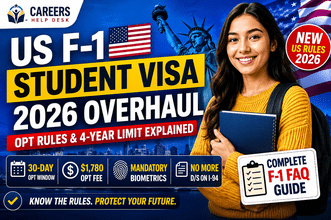
The United States Department of Homeland Security (DHS) published a final rule replacing “Duration of Status” (D/S) admission with fixed periods of admission for F-1, J-1, and I nonimmigrants. The rule is currently scheduled to take effect on 15 September 2026. However, DHS states that congressional review could change the effective date or terminate the rule. Applicants should therefore check the Federal Register and official DHS guidance before making immigration decisions. Under the new system, Customs and Border Protection (CBP) officers will assign a fixed expiration date on your Form I-94 rather than granting open-ended D/S admission. This change shifts extension decisions from university Designated School Officials (DSOs) to United States Citizenship and Immigration Services (USCIS).
US Student Visa D/S Policy Shift: Quick Summary
| Policy Parameter | Legacy System (Pre-Sept 2026) | Final Rule ( Schedule Effective date 15 Sept 2026) |
| I-94 Admission Stamp | Marked as “D/S” (Duration of Status) | Fixed expiration date (Max 4 years) |
| Post-Study Grace Period | 30 days under the fixed-date admission system. Eligible F-1 students covered by the D/S transition provision retain a 60-day departure period. | 30 days following program end |
| Program Extensions | Issued directly by DSO in SEVIS | Requires formal USCIS Form I-539 approval |
| OPT / STEM OPT Extension | Single Form I-765 submitted to USCIS | Form I-539 and Form I-765 may both be required when an extension of stay is necessary. A temporary transition exemption applies to eligible post-completion OPT and STEM OPT applications filed on or before 18 March 2027. |
| Same-Level Second Degrees | Permitted (e.g., earning a 2nd Master’s) | Strictly prohibited under F-1 status |
| First-Year Major Switches | Permitted through institutional approval | Prohibited for graduate degree levels |
Important Transition Exception: F-1 students who validly maintain D/S status on 15 September 2026 may remain under the transition provision until the program end date shown on their valid Form I-20 or until 15 September 2030, whichever comes first. These students also retain a 60-day departure period. International travel after the rule takes effect can move the student into the fixed-date admission system upon reentry.
Critical International Travel Warning: If you leave the United States after the rule takes effect, you can no longer rely on your previous D/S admission when you return. CBP may readmit you under a fixed Form I-94 expiration date based on your Form I-20 and the new admission limits. Review your I-94 immediately after every entry.
Opportunity & Entity Snapshot
The Department of Homeland Security enforces these strict nonimmigrant limits to increase oversight across American higher education institutions. Understanding how government bodies interact helps you preserve your legal standing.
- The Department of Homeland Security (DHS) promulgates nonimmigrant admission rules.
- U.S. Citizenship and Immigration Services (USCIS) adjudicates Form I-539 Extension of Stay requests.
- Customs and Border Protection (CBP) assigns fixed I-94 expiration dates at ports of entry.
- Designated School Officials (DSOs) issue Form I-20 documents while losing direct extension authority.
Core Regulatory Impacts on International Students
DHS replaces the flexible D/S system with rigid statutory cutoffs. These operational adjustments alter how you manage your academic progression inside the United States.
1. The 4-Year Fixed Admission Ceiling
Customs and Border Protection officers now admit F-1 students for the exact period listed on their Form I-20, not to exceed four maximum years. If your PhD program or medical residency requires five or six years to complete, you must file a formal extension request with USCIS before your four-year mark expires.
2. Mandatory USCIS Extension of Stay (Form I-539)
Under the old system, your campus DSO extended your stay by generating a new Form I-20 in SEVIS. Under the final rule, you must submit Form I-539 (Application to Extend/Change Nonimmigrant Status) directly to USCIS. This application requires the applicable government filing fee and supporting evidence showing your eligibility, financial resources, and reason for requesting additional time. USCIS may also require biometrics or an interview as part of the adjudication process.
3. Grace Period Reduction
DHS slashes the post-completion preparation window from 60 days to 30 days. Following your graduation date or OPT expiration date, you have exactly 30 days to depart the United States, execute a school transfer, or submit a change-of-status petition to USCIS.
4. Prohibition on Horizontal Degree Progression
The final rule eliminates “forever student” pathways. Once you complete an academic degree level (such as a Master of Science), you cannot maintain F-1 status by enrolling in a second degree at the exact same or lower educational level. You must continuously progress upward to a higher degree level, such as moving from a Master’s degree to a Doctoral program.
Mega Q&A: Navigating the 2026 Duration of Status Rule
Q1: What happens to F-1 students currently studying in the US under D/S?
It depends on your Form I-20 end date and whether you travel internationally. If you validly maintain F-1 D/S status when the rule takes effect, you generally do not need to file an immediate Form I-539 application.
You may remain under the transition provision until the program end date shown on the Form I-20 that was valid on the effective date or until four years after the rule takes effect, whichever comes first. Qualifying F-1 students also retain a 60-day departure period after completing their program or practical training.
You must apply for an extension of stay if your academic program continues beyond the applicable transition deadline. Leaving the United States and returning after the rule takes effect can place you under the new fixed-date I-94 system.
Q2: Can I travel outside the United States after 15 September 2026?
Yes, but travel carries structural changes. Returning to the US automatically terminates your legacy D/S status. CBP officers will issue you a new fixed-date I-94 record capped at your remaining Form I-20 time or four years max. Immigration attorneys advise students with complex academic timelines to avoid unnecessary international travel to prevent premature fixed-date cutoffs.
Q3: How do I apply for post-completion OPT under the new fixed admission system?
It depends on your filing date and whether the transition exemption covers you. An F-1 student recommended for post-completion OPT who submits Form I-765 on or before 18 March 2027 may qualify for a temporary exemption from filing Form I-539 for the requested OPT period.
The same temporary exemption applies to eligible STEM OPT extension applications filed on or before 18 March 2027. DHS may extend this exemption through a later Federal Register notice.
Outside this exemption, you may need to file Form I-539 together with Form I-765 when your authorized period of admission does not cover the requested OPT or STEM OPT period. Follow the latest USCIS form instructions and confirm your filing strategy with your DSO.
Q4: What happens if my PhD program takes 5 years to complete?
Because CBP caps initial admission at four years, you must file Form I-539 with USCIS during your fourth academic year. You should submit this extension application up to 180 days before your four-year I-94 expiration date to prevent unlawful presence accrual while USCIS processes your request.
Q5: Can graduate students change their academic major or program?
No. The final rule strictly bars graduate F-1 students from changing their field of study or degree program mid-course. Undergraduate students face a one-year ban on changing majors during their freshman year. If you realize your graduate program is an ill fit, you must apply for a formal exception or re-apply under new immigration parameters.
Q6: How does this rule affect the H-1B Cap-Gap extension?
Yes, the final rule preserves H-1B cap-gap protection for eligible F-1 students. If an employer files a qualifying cap-subject H-1B petition and change-of-status request on time, the automatic extension of F-1 stay and eligible employment authorization continues through 1 April of the relevant fiscal year or until the approved H-1B petition’s validity start date, whichever occurs first.
You do not need a separate Form I-539 solely to receive this cap-gap protection when the regulatory requirements apply.
Q7: Can I continue studying while my Form I-539 extension is pending with USCIS?
Yes, you may continue a full course of study while USCIS reviews a timely filed Form I-539 extension request. USCIS considers you to be in an authorized period of stay from the expiration of your Form I-94 until it decides your extension application.
The 240-day limit does not restrict your continued enrollment. It applies only to the automatic continuation of certain employment authorization.
If you file Form I-539 before your authorized admission period expires, you may continue qualifying:
- On-campus employment
- Curricular Practical Training (CPT)
- Approved severe economic hardship employment
This automatic employment continuation lasts for up to 240 days after your Form I-94 expires, or until USCIS decides your application, whichever occurs first.
However, the rule does not automatically authorize all practical training. You generally cannot begin or continue pre-completion OPT, post-completion OPT, or employment with an international organization after your admission period expires until USCIS approves the required extension and employment authorization applications.
If you file Form I-539 during the new 30-day departure period, you may continue studying, but you cannot rely on the 240-day automatic employment extension.
Q8: How does the Duration of Status elimination affect J-1 exchange visitors?
Yes, the final rule also replaces D/S admission for J-1 exchange visitors with a fixed period of admission. CBP may admit a J-1 visitor until the program end date listed on Form DS-2019, subject to a maximum initial period of four years.
J-1 scholars, researchers, physicians, interns, trainees, and other exchange visitors must still follow the separate time limits attached to their specific exchange categories under Department of State regulations. The four-year admission ceiling does not override a shorter category-specific limit.
A sponsor’s decision to issue an extended Form DS-2019 does not automatically extend the J-1 visitor’s lawful admission. If the new program or Academic Training period extends beyond the fixed Form I-94 date, the J-1 visitor must file Form I-539, or a successor form designated by USCIS, with the valid Form DS-2019 and applicable supporting evidence.
J-1 visitors generally receive an additional 30-day period after the program end date or maximum authorized admission period to depart or take another permitted action.
Q9: Can I transfer to a different US university after arriving in the country?
It depends on your academic level and whether you have completed your first academic year. An F-1 student studying below the graduate degree level generally cannot transfer schools or change educational objectives during the first academic year unless SEVP authorizes an exception for extenuating circumstances.
After completing the first academic year, an eligible undergraduate student may transfer to another SEVP-certified school if the student continues to maintain valid F-1 status and satisfies the official transfer requirements.
An F-1 student enrolled in a graduate-level program or higher generally cannot transfer schools or change majors at any point during that program. SEVP may authorize an exception when extenuating circumstances prevent the original institution from continuing to provide the approved course of study.
Examples may include:
- A permanent or extended school closure
- A school merger that eliminates the student’s program
- Loss of the institution’s authority to enroll F-1 students
- A natural disaster that prevents the school from providing required instruction
- A comparable emergency beyond the student’s control
The rule refers to the school that initially issued your Form I-20, not the institution listed on your visa.
Implementation warning: DHS may delay or suspend the school-transfer and educational-objective restrictions until 14 September 2028 if implementation proves infeasible. Check the latest SEVP notice before relying on these restrictions.
Q10: How much are the USCIS filing fees for Form I-539?
US$420 for online filing and US$470 for paper filing. These are the general Form I-539 filing fees listed by USCIS as of July 2026.
Not every applicant or filing situation qualifies for online submission. Applicants filing with dependents, submitting Form I-539A, requesting reinstatement, or combining multiple applications should follow the exact USCIS filing instructions for their category.
USCIS can revise its fees. Always confirm the current amount through the official Form G-1055 Fee Schedule on the day you submit your application. USCIS may reject an application that includes an incorrect payment.
Action Plan for International Students
Stage 1: Verify Your I-94 Document
Access the official CBP I-94 website. Save a digital copy of your current arrival record to verify whether your entry reads “D/S” or displays a fixed expiration date.
Stage 2: Audit Your Program Timeline
Compare your Form I-20 end date against your academic roadmap. If your PhD, medical residency, or dual degree extends beyond four years, mark your fourth-year calendar for a USCIS extension filing.
Stage 3: Pause Non-Essential Travel
Evaluate all international travel plans scheduled after 15 September 2026. Consult your DSO before booking overseas flights to understand how readmission alters your I-94 status.
Stage 4: Prepare Extension Documents Early
Gather bank statements, academic transcripts, and formal DSO support letters six months before your fixed I-94 date expires.
Stage 5: Check the OPT Transition Exception
Before submitting Form I-539, determine whether the temporary OPT or STEM OPT exemption applies to your case. Eligible applications filed on or before 18 March 2027 may require only Form I-765. Outside that exemption, file Form I-539 concurrently when you need an extension of stay to cover the requested employment authorization period.
Careers Help Desk Strategic Counter-Angle & Competitive Edge
Average blogs offer basic summaries of immigration announcements. To protect your legal standing and outsmart automated processing queues, implement these strategic adjustments:
- Treat the I-94 Date as Your Hard Legal Ceiling: Under the fixed-date system, your Form I-94 controls the end of your authorized admission period. A later Form I-20 end date does not automatically extend that period. If you do not leave, change status, or file a timely extension request, you may begin accruing unlawful presence after your authorized stay ends. Multi-year reentry bars do not begin after a single day. The three-year bar generally requires more than 180 days of unlawful presence, while the ten-year bar generally requires one year or more, followed by departure or removal from the United States.
- Avoid Same-Level “Day-1 CPT” Master’s Hopping: Thousands of graduates rely on enrolling in a second Master’s degree to utilize Day-1 Curricular Practical Training (CPT) after missing the H-1B lottery. The final rule completely locks down this pathway by prohibiting same-level F-1 degree progression. Plan alternative visa routes (such as O-1, Cap-Exempt H-1B, or employment sponsorship) early.
- File Form I-539 as Early as USCIS Permits: DHS encourages nonimmigrants to submit extension-of-stay applications during the six months before their authorized stay expires. Filing early gives USCIS more time to review your request and reduces the risk of academic or employment disruption. A properly and timely filed extension request can allow you to remain in an authorized period of stay while USCIS reviews the application. However, the 240-day employment provision does not cover every type of F-1 employment. It applies only to specific employment categories and circumstances described in the final rule. Avoid international travel while Form I-539 remains pending unless you first confirm how departure will affect the application.
Alternative Global Study & Work Options
- If you seek flexible post-study work routes without fixed visa caps: Read our complete review of the Germany Opportunity Card (Chancenkarte) Rules.
- If you want direct permanent residency pathways following graduation: Explore our guide on Canada Post-Graduation Work Permit (PGWP) Changes.
- If you need fully funded European postgraduate research options: Review our application blueprint for the Humboldt Research Fellowship Germany 2026–2027.
Common Mistakes to Avoid
- Assuming Your DSO Can Extend Your Stay in SEVIS: Relying solely on a updated Form I-20 without submitting Form I-539 to USCIS causes you to fall out of legal status.
- Planning for a 60-Day Post-Graduation Departure Window: Leaving the country on day 45 post-graduation now constitutes an unlawful overstay under the new 30-day limit.
- Enrolling in a Second Master’s Degree Under F-1: Attempting to maintain status via a horizontal degree move triggers an immediate visa denial.
- Travelling Internationally Unprepared: Flying overseas after 15 September 2026 converts your legacy D/S status into a strict fixed-date I-94 upon re-entry.
Final Application Advice
The elimination of Duration of Status marks a major structural shift in US immigration management. While the new requirements add administrative steps and USCIS filing fees, staying informed helps you avoid accidental status violations. Audit your Form I-94, track your program completion dates, and coordinate directly with your university international office well before your four-year ceiling arrives.
Regulatory Status Notice: DHS published this final rule on 17 July 2026 and currently lists 15 September 2026 as its effective date. Because the rule remains subject to congressional review, DHS may publish a later Federal Register notice changing the effective date or terminating the rule. Always verify the latest official guidance before filing an immigration application or making international travel decisions.
Official Sources & Legal Resources
- DHS Federal Register Official Final Rule Notice
- U.S. Department of Homeland Security Official Announcement
- Study in the States Official D/S Elimination Guidance
Frequently Asked Questions
Does the 4-year fixed admission cap mean my degree must finish in 4 years?
No. The 4-year limit reflects the maximum initial stay granted upon entry. If your academic program takes longer (such as a 5-year PhD), you can legally extend your stay by filing Form I-539 with USCIS.
Is the F-1 grace period still 60 days?
It depends on which admission system covers you. Eligible F-1 students who maintain D/S status on the rule’s effective date retain a 60-day departure period under the transition provision. F-1 students admitted under the new fixed-date system generally receive a 30-day period after completing their course of study or authorized practical training to depart, change status, or take another permitted action.
Do I need to apply for an extension if I do not travel outside the US?
No, not immediately, if the transition provision covers you and you continue maintaining valid F-1 status. You may generally remain until the program end date on the Form I-20 that was valid when the rule took effect or until four years after the effective date, whichever comes first. You must file an extension-of-stay application if you need to continue your program beyond that applicable deadline. International travel can move you into the fixed-date admission system when you return.
Can I change my graduate major under the new rule?
No. The final rule prohibits graduate-level F-1 students from changing their program or field of study mid-degree.
Stay Connected wth Careers Help Desk to discover the latest fully funded scholarships, fellowships, internships, research positions, and graduate programs available for international students as well as the latest news and updates.

0 Comments