The Cornell Atkinson Postdoctoral Fellowship in Sustainability 2027 is now open, offering a $65,000 annual salary, full Cornell employee benefits and $12,000 per year for research and travel expenses. Hosted by the Cornell Atkinson Center for Sustainability at Cornell University, the three-year fellowship supports early-career researchers working on climate risk, energy transitions, food security and One Health. Applications close on October 20, 2026, at 5:00 p.m. ET, with successful fellows starting between June 1 and September 1, 2027. Unlike a conventional postdoc, applicants must build their proposed research around both a Cornell faculty mentor and an external partner organization. That research-to-impact structure is central to the fellowship, connecting academic research with practical sustainability challenges in government, industry, nonprofits and other real-world settings.
Cornell Atkinson Postdoctoral Fellowship 2027: Quick Overview
| Detail | Information |
|---|---|
| Host | Cornell Atkinson Center for Sustainability |
| University | Cornell University |
| Location | Ithaca, New York, USA |
| Fellowship length | Up to 3 years |
| Annual salary | $65,000 |
| Research and travel support | $12,000 per year |
| Benefits | Full Cornell University employee benefits |
| Research areas | Climate Risk, Energy Transitions, Food Security, One Health |
| Positions | Up to 4 fellows per year |
| PhD requirement | PhD received by fellowship start and no earlier than May 1, 2025 |
| Start date | June 1 to September 1, 2027 |
| Application deadline | October 20, 2026, 5:00 p.m. ET |
What Is the Cornell Atkinson Postdoctoral Fellowship?
The Cornell Atkinson Fellowship is designed for recent PhD graduates who want to connect rigorous academic research with practical sustainability challenges.
Fellows receive a three-year, 12-month appointment at Cornell University. Continued support in the second and third years depends on satisfactory progress and funding availability.
The programme sits within Cornell Atkinson’s broader research-to-impact mission, which connects researchers with government, nonprofit organizations, businesses and communities. Rather than viewing publication as the end point, the fellowship encourages researchers to think about how evidence can influence technology, practice, decision-making and policy.
This distinction matters when preparing an application.
A technically excellent research proposal may not be enough on its own. Applicants also need to show who can use the research, how the external partner contributes and what pathway could move the results beyond academia.
Researchers exploring other international opportunities may also want to compare this fellowship with our guides to fully funded postdoctoral fellowships abroad including MOPGA Fellowship 2027 in France and University of Konstanz Postdoctoral Fellowships 2027 and research fellowships for international applicants such as Georg Arnhold Senior Fellowship 2028 in Germany.
What Research Areas Are Eligible?
Proposed research must align with at least one of Cornell Atkinson’s four priority areas:
- Reducing Climate Risk
- Accelerating Energy Transitions
- Increasing Food Security
- Advancing One Health
These categories are broad enough to accommodate researchers from different disciplines.
For example, energy-transition research can involve renewable fuels, clean-energy technologies, smart systems, demand response, energy accessibility and related policy questions. Climate-risk research can include emissions reduction, climate adaptation, resilient infrastructure, agriculture and financial approaches to climate risk.
One Health connects human wellbeing with animals, ecosystems, pollution, food, water and environmental conditions.
This means applicants should not assume the fellowship is restricted to environmental science. Engineering, economics, health, data science, policy, agriculture and interdisciplinary research may fit when the proposed problem clearly connects with one or more sustainability themes.
If your work sits closer to climate or clean-energy innovation, you can also explore our guides to Climate Tech Fellowship 2026 in USA and energy-transition research opportunities including ERC Consolidator Grant 2027 for alternative routes.
Who Can Apply?
Applicants must have received a PhD in a field relevant to their proposed project by the time the fellowship begins.
For the 2027 cycle, the PhD must have been awarded no earlier than May 1, 2025.
There is another important eligibility condition: the programme is intended to bring researchers from outside Cornell into its academic community. Cornell PhD graduates and current Cornell postdocs are not eligible.
International researchers can apply. Successful applicants who require visa sponsorship are referred to Cornell International Services for guidance.
The fellowship is also clearly a US-based, in-person appointment. Fellows must maintain their primary residence in Ithaca, New York, and spend most of their time on campus. Remote and hybrid appointments are not permitted, although fieldwork and research visits can form part of a project.
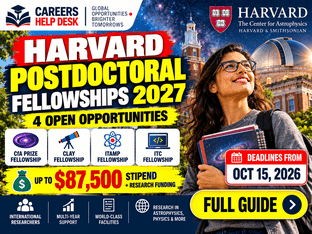
For researchers comparing options internationally, our postdoctoral fellowships in the USA guides including Harvard Postdoctoral Fellowships 2027, Harvard Kempner Research Fellowship 2027 and Stanford APARC Fellowships 2027 can help place this opportunity alongside other US-based programmes.
You Need Both a Cornell Mentor and an External Partner
This is one of the most important parts of the application.
Before applying, candidates must secure:
- A PI-eligible Cornell faculty mentor who is currently a Cornell Atkinson Faculty Fellow.
- A primary adviser from an eligible external organization.
The external partner can come from government, a nonprofit organization or the private sector. Another university or higher education institution cannot serve as the external partner.
There is also a constraint applicants should address early: a Cornell faculty mentor may support only one fellowship applicant during the cycle.
Finding a professor whose research matches yours is therefore only the first step. You also need to confirm that the faculty member is willing and eligible to support your specific application.
Applicants still searching for an academic host may find our Professor Cold Email Generator useful for structuring a concise first-contact message around research fit rather than sending a generic request.
Cornell Atkinson Fellowship Application Requirements
Applications must be submitted through the online application system by October 20, 2026, at 5:00 p.m. ET.
Apply for Cornell Atkinson Postdoctoral Fellowship 2027 Via Online Appliation Form
The application includes a 250-word project abstract covering the proposed project, methods and expected impact.
Applicants must also upload a single PDF containing several components.
The Applicant Background, limited to 250 words, should summarize your doctoral work, future career direction and how the fellowship would support your development in sustainability research and impact.
The Project Description can be up to 1,000 words, excluding references. It should explain the research context, objectives, methods, significance, required resources and the role of the external partner.
Applicants also prepare an Impact Statement of up to 300 words. Cornell specifically asks candidates to explain how their research could influence behavior, practice, procedures or policy at the relevant scale.
A CV is also required, with accepted and published papers clearly identified and DOI information included where applicable.
Researchers preparing several applications at once can also use our Scholarship Eligibility Checker to organize basic eligibility questions before spending significant time on application materials.
Four Recommendation Letters Are Required
The recommendation process deserves early attention because four letters are required and they are due on the same day as the main application.
One letter must come from the proposed Cornell faculty mentor.
A second comes from the primary adviser at the external partner organization.
A third should normally come from the applicant’s doctoral adviser.
The fourth can come from an academic or non-academic professional who knows the applicant’s work well enough to discuss both their capabilities and proposed research.
Recommenders submit letters separately by email.
This makes the fellowship harder to assemble at the last minute than a standard CV-and-research-proposal application. Your mentor and external partnership are not supporting details. They are part of the architecture of the proposal.
Careers Help Desk Counter Angle: Build the Partnership Before Polishing the Proposal
The natural instinct with a competitive postdoc is to start writing the research proposal immediately. For this fellowship, that may be the wrong order.
Start with the problem-partnership-impact triangle.
Ask three questions: What sustainability problem are you solving? Which Cornell researcher gives you the right academic environment? Which external organization can realistically use, test, shape or apply the resulting knowledge?
Only then should you lock down the project narrative.
A weak application may describe an impressive research problem and add an external organization near the end simply because the programme requires one. A stronger structure makes the partner necessary to the research-to-impact pathway.
The impact statement should follow the same logic. Avoid treating “impact” as a promise that the research will somehow help society. Identify the potential user, the decision or practice that could change, and the mechanism connecting your findings to that change.
That approach also makes the Cornell mentor and external adviser easier to justify because each person has a defined role.
How Are Fellows Selected?
Applications first undergo eligibility and completeness checks.
Eligible proposals are then assessed for their alignment with Cornell Atkinson’s priority areas, research quality, potential impact and the applicant’s academic background and experience.
Promising applications move to a broader review involving Cornell Atkinson Faculty Fellows, after which selected candidates may be invited for interviews.
Ultimately, up to four fellows are selected each year.
Applicant notifications are expected in January 2027, with fellowship appointments beginning between June 1 and September 1, 2027.
What Does the Fellowship Provide?
Each Cornell Atkinson Postdoctoral Fellow receives:
- $65,000 annual salary
- Full Cornell University employee benefits
- $12,000 per year for research and travel
- A three-year appointment, subject to annual progress and funding conditions
- Professional development through the Sustainability Leadership Program
The leadership programme adds another layer to the fellowship. Fellows receive training in areas such as science communication, career strategy, public engagement and collaborative leadership.
That can be particularly useful for researchers considering careers that cross the traditional academic boundary into government, industry, nonprofits, sustainability strategy or research translation.
Ready to Apply for Fellowships in the United States?
The Cornell Atkinson Postdoctoral Fellowship 2027 is particularly relevant for early-career researchers who want their sustainability work to move beyond academic publication. The combination of a Cornell faculty mentor, an external partner, three years of research time and dedicated research funding creates room for projects that connect scientific depth with implementation. But applicants should not wait until the final days to build that structure. With a Cornell mentor, external adviser and four recommendation letters required by October 20, 2026, the partnership side of the application deserves attention as early as the proposal itself. For complete eligibility rules, application materials and submission instructions, applicants should review the official Cornell Atkinson 2027 Call for Applications and the Cornell Atkinson Postdoctoral Fellowship page before applying.
Official Source: Cornell Atkinson Postdoctoral Fellowship in Sustainability 2027 Call for Applications
Frequently Asked Questions (FAQs)
Is the Cornell Atkinson Postdoctoral Fellowship 2027 open?
Yes. The 2027 Cornell Atkinson Postdoctoral Fellowship application cycle is open. Applications and recommendation letters must be submitted by October 20, 2026, at 5:00 p.m. ET. Applicant notifications are expected in January 2027. Pasted markdown
How much is the Cornell Atkinson Postdoctoral Fellowship salary?
Cornell Atkinson Postdoctoral Fellows receive a $65,000 annual salary, full Cornell University employee benefits, and $12,000 per year for research and travel expenses. The fellowship is structured as a three-year appointment, with later-year support dependent on satisfactory progress and funding availability. Pasted markdown
Who is eligible for the Cornell Atkinson Postdoctoral Fellowship 2027?
Applicants must receive their PhD in a field relevant to the proposed research by the fellowship start date. For the 2027 cycle, the PhD cannot have been received earlier than May 1, 2025. Cornell PhD graduates and Cornell postdocs are not eligible for this programme. Pasted markdown
Can international researchers apply for the Cornell Atkinson Fellowship?
Yes. Applicants who meet the programme requirements are encouraged to apply. Successful candidates who need visa sponsorship are referred to Cornell International Services for guidance on obtaining the appropriate US visa for employment. Pasted markdown
Do I need a Cornell professor before applying?
Yes. Applicants must secure a PI-eligible Cornell faculty mentor who is currently a Cornell Atkinson Faculty Fellow. A faculty mentor can support only one fellowship applicant per application cycle, so applicants should confirm their mentor’s availability early. Pasted markdown Pasted markdown
Do I need an external partner for the Cornell Atkinson Fellowship?
Yes. Applicants need an adviser from an external organization that will collaborate on the proposed project. The organization may be from the government, nonprofit or private sector, but another university or higher education institution cannot serve as the external partner. Pasted markdown
How many recommendation letters are required?
Applicants need four recommendation letters: one from the Cornell faculty mentor, one from the primary adviser at the external organization, normally one from the applicant’s doctoral adviser, and one additional professional reference. All letters are due by October 20, 2026, at 5:00 p.m. ET. Pasted markdown
Stay connected with Careers Help Desk for the latest international fellowships, scholarships, research opportunities and jobs abroad to empower your future!



0 Comments