The TWAS-FAPESP Postdoctoral Fellowship 2027 in Brazil offers funded research opportunities for PhD graduates from developing countries for up to 12 months. The World Academy of Sciences (TWAS) and the São Paulo Research Foundation (FAPESP) support international researchers in natural, applied and social sciences through this programme. Successful applicants conduct research at universities and research institutions in São Paulo State, Brazil.
Applications for the 2026–2027 fellowship cycle are now open. The first deadline is November 1, 2026, for supervisors to submit expressions of interest, followed by the April 1, 2027 deadline for full research proposals. You cannot apply independently. You must secure an eligible supervisor in São Paulo whose ongoing FAPESP-funded project aligns with your research. Your supervisor then submits the full application through FAPESP’s online system.
TWAS-FAPESP Postdoctoral Fellowship 2027: Quick Overview
| Category | Details |
|---|---|
| Host Country | Brazil |
| Funding Organizations | TWAS and FAPESP |
| Programme | TWAS-FAPESP Postdoctoral Fellowship |
| Research Location | São Paulo State |
| Academic Level | Postdoctoral Research |
| Funding | Monthly fellowship, research overhead and applicable additional benefits |
| Duration | Up to 12 months |
| Eligible Applicants | Natives and permanent residents of eligible developing countries |
| Academic Qualification | PhD obtained within the previous seven years |
| Age Limit | None |
| Preliminary Deadline | November 1, 2026 |
| Supervisor List | December 1, 2026 |
| Full Application Deadline | April 1, 2027, midnight Brasília Time (BRT) |
| Application Method | Online through FAPESP’s SAGe system, submitted by the supervisor |
The official call opened on September 8, 2026. TWAS and FAPESP expect to announce successful proposals in August 2027, with approved research projects starting from August 2027.
What Is the TWAS-FAPESP Postdoctoral Fellowship?
The programme supports researchers from developing countries who want to conduct advanced scientific research within established research groups in São Paulo.
TWAS collaborates with FAPESP to provide international postdoctoral research opportunities, while FAPESP manages the research funding and proposal assessment.
The programme follows several important institutional arrangements:
- TWAS partners with FAPESP to support researchers from developing countries.
- FAPESP funds eligible postdoctoral research at institutions in São Paulo State.
- São Paulo host supervisors submit fellowship proposals through FAPESP’s SAGe system.
- Postdoctoral fellows contribute to existing FAPESP-funded research projects.
The programme differs from an independent research grant. Your proposed research must fit the scientific objectives of a host supervisor’s active project.
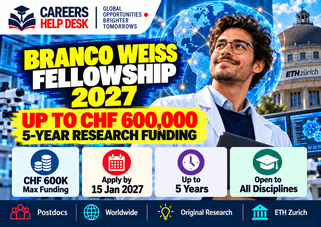
If you want greater freedom to develop your own research direction, consider the Branco Weiss Fellowship 2027, which provides up to CHF 600,000 over five years for eligible postdoctoral researchers across disciplines.
Available Research Fields
TWAS accepts applications across ten broad scientific areas:
- Agricultural Sciences
- Structural, Cell and Molecular Biology
- Biological Systems and Organisms
- Medical and Health Sciences, including Neurosciences
- Chemical Sciences
- Engineering Sciences
- Astronomy, Space and Earth Sciences
- Mathematical Sciences
- Physics
- Social and Economic Sciences
Your research discipline alone does not determine eligibility. You must also identify a qualified supervisor whose FAPESP-funded project can accommodate your proposed research.
If your research focuses on cybersecurity, digital technologies or related fields, explore the CYD Postdoctoral Fellowship Switzerland for another research opportunity outside Brazil.
Who Can Apply for the TWAS-FAPESP Fellowship 2027?
You can apply if you are a native and permanent resident of an eligible developing country, hold a PhD or equivalent degree in a supported discipline, and apply within seven years of obtaining your doctorate. You must secure an eligible São Paulo supervisor and demonstrate sufficient English proficiency for your research.
The official eligibility requirements include:
- Nationality and residence: You must be a native and permanent resident of a country on the TWAS developing-country list.
- Brazil residency: You must not already be in Brazil or hold a temporary or permanent residence visa in Brazil or a developed country.
- Education: You must hold a doctorate or equivalent degree in natural, applied or social sciences.
- PhD completion: You must apply within seven years of obtaining your doctorate.
- Age: The programme has no age limit.
- Supervisor acceptance: You must obtain acceptance from an eligible supervisor at a host institution in São Paulo State.
- English: Your supervisor must formally confirm that your oral and written English proficiency meets the research project’s requirements.
The call specifies a supervisor’s formal statement as evidence of English proficiency. It does not establish a universal IELTS or TOEFL score requirement.
FAPESP’s general postdoctoral guidelines also allow certain exceptions concerning the period since PhD completion under PR Ordinance No. 171/2024. Applicants who need such an exception should check the applicable rules before proceeding.
If you are considering postdoctoral research in Canada, the UBC Killam Postdoctoral Research Fellowship 2027–2028 offers a $60,000 annual stipend for up to two years. The application process begins with a departmental nomination.
How to Find a Supervisor in São Paulo, Brazil
The supervisor search is a central part of this application.
TWAS identifies several universities where applicants can explore research opportunities:
| University | Official Website |
|---|---|
| University of São Paulo (USP) | usp.br |
| University of Campinas (UNICAMP) | unicamp.br |
| São Paulo State University (UNESP) | unesp.br |
| Federal University of São Carlos (UFSCar) | ufscar.br |
| Federal University of ABC (UFABC) | ufabc.edu.br |
| Federal University of São Paulo (UNIFESP) | unifesp.br |
You should not assume every professor at these institutions qualifies.
For this call, the supervisor must meet the programme’s specific requirements, including participation in an eligible ongoing FAPESP research grant that remains valid until at least August 2027.
The supervisor must also submit an expression of interest by November 1, 2026. FAPESP plans to publish the list of eligible potential supervisors on December 1, 2026.
This creates a practical opportunity: you can review the official supervisor list, identify projects that match your expertise and approach researchers with a specific proposal rather than sending generic requests.
If you have not yet completed a PhD and want to pursue doctoral research abroad, explore the latest Fully Funded PhD Scholarship Positions 2027 for postgraduate study abroad.
TWAS-FAPESP Fellowship 2027 Application Timeline
| Stage | Official Date |
|---|---|
| Call Opens | September 8, 2026 |
| Supervisor Expression of Interest Deadline | November 1, 2026 |
| Eligible Supervisor List Published | December 1, 2026 |
| Full Proposal Deadline | April 1, 2027 |
| Selection Results | August 2027 |
| Research Projects Begin | From August 2027 |
The official call specifies midnight Brasília Time for deadlines. Applicants outside Brazil should account for the time difference.
November 1 is the supervisor’s preliminary deadline, not the candidate’s full application deadline. However, the first stage determines which supervisors can participate in the subsequent process.
Required Documents for the TWAS-FAPESP Fellowship
The full proposal requires documents from both you and your host supervisor.
Prepare the following materials according to the programme-specific requirements:
- Research project: Maximum four pages, written in English, explaining how your work contributes to the supervisor’s existing FAPESP-funded project.
- Linked research grant summary: An English summary of the ongoing FAPESP project.
- Supervisor’s curricular summary: Prepared in English according to FAPESP guidelines.
- Official PhD academic transcript: Including course names, grading criteria and institutional authentication, in English.
- Principal Investigator’s agreement: A signed Portuguese statement when the proposed supervisor is not the responsible researcher for the linked grant.
- Host institution director’s statement: Using the Portuguese template available in SAGe.
- Institutional infrastructure statement: Using the required Portuguese template.
- Data Management Plan: Maximum two pages, in English.
- English proficiency statement: A formal declaration from the supervisor confirming the candidate’s language ability.
FAPESP’s general postdoctoral guidelines also require a candidate curricular summary and updated SAGe registration details. Both the applicant and supervisor should review the programme-specific checklist alongside the general rules.
After approval, successful candidates must provide additional materials, including proof of PhD completion, employment or leave documentation where applicable, and a postdoctoral development plan.
How to Apply for the TWAS-FAPESP Postdoctoral Fellowship 2027
The application process has two connected stages.
Step 1: Identify your research area. Review the supported disciplines and identify how your PhD experience can contribute to an existing research project.
Step 2: Find an eligible supervisor. Explore São Paulo research institutions and the official supervisor list when FAPESP publishes it on December 1, 2026.
Step 3: Obtain supervisor acceptance. Discuss your research interests, project feasibility and the requirements for a conditional acceptance letter.
Step 4: Register in SAGe. Create your beneficiary account through the FAPESP SAGe system, using ORCID or the full registration process.
Create Account on FAPESP SAGe system for Fellowship Applications
Step 5: Prepare the research proposal. Work with your supervisor to produce the four-page project and supporting documents.
Step 6: Submit through the supervisor. Your supervisor submits the application using the relevant UNESCO/TWAS cooperation agreement funding line in SAGe.
Step 7: Complete submission before April 1, 2027. Check that SAGe includes your name in the Beneficiary field and that the application contains all mandatory documents.
Your supervisor controls the formal submission. You should therefore agree on an internal completion date that leaves sufficient time for institutional approvals and document verification.
If you prefer graduate study in Europe, the France Excellence Eiffel Scholarship 2027 supports eligible international master’s and doctoral applicants through participating French institutions.
Careers Help Desk Counter Angle: What Actually Strengthens Your Application?
The most important competitive advantage is understanding what FAPESP evaluates.
Its official review framework assesses the research project, candidate’s academic background and supervisor’s research background. Meeting the eligibility requirements does not establish that your proposal meets these scientific standards.
Three practical strategies follow from these criteria.
1. Show what you contribute to the host project
Many applicants describe their PhD research and ask whether a professor has an available position.
That approach misses the central funding requirement.
FAPESP expects your postdoctoral research to contribute directly to an ongoing funded project. Read the supervisor’s recent publications and identify a specific research question that your expertise can help address.
For example, if you have experience in process simulation and a research group works on experimental biomass conversion, you can explain how your modelling skills would support its experimental programme.
The connection should appear in your proposed objectives, methods and expected results.
2. Design a project that fits 12 months
A long research proposal does not automatically demonstrate ambition.
FAPESP explicitly evaluates project feasibility and identifies excessive or poorly defined objectives among common application weaknesses.
Build your four-page proposal around a focused scientific question, realistic methods and outcomes that the host laboratory can achieve within the fellowship period.
A manageable project with a credible scientific contribution offers reviewers stronger evidence of feasibility than an extensive plan that depends on uncertain experiments, facilities or collaborations.
3. Choose your supervisor for research fit, not university reputation alone
A prestigious university name cannot compensate for an unsuitable supervisor.
FAPESP evaluates the supervisor’s research achievements, experience, availability and ability to support the project.
Look for evidence that the supervisor has relevant funding, suitable facilities and an active research programme that needs your expertise.
This matters particularly because each supervisor can submit only one proposal under this call. Your initial discussion should establish whether the supervisor can support your candidacy and how your work fits the research grant.
For researchers developing more independent scientific ideas, the [Internal Link Opportunity: Branco Weiss Fellowship 2027] offers a useful comparison because its funding approach places greater emphasis on unconventional research proposals.
Common Application Mistakes to Avoid
FAPESP identifies several recurring problems in postdoctoral applications. You can reduce these risks before submission.
- Contacting an ineligible supervisor: Confirm the supervisor’s grant status and participation in the call.
- Submitting a disconnected project: Explain the relationship between your proposal and the existing FAPESP research grant.
- Exceeding the research project limit: Keep the project within four pages.
- Ignoring document requirements: Verify the required language, institutional signatures and academic transcript authentication.
- Writing unclear objectives: State what you will investigate, how you will investigate it and what results you expect.
- Submitting a weak Data Management Plan: Address the data your project will generate and how you will manage it.
- Leaving SAGe registration until the deadline: Complete your beneficiary registration before your supervisor prepares the final submission.
The application also requires careful attention to employment arrangements. FAPESP normally expects fellows to dedicate themselves exclusively to the research project, subject to its rules on approved exceptions and leave arrangements.
TWAS-FAPESP Postdoctoral Fellowship Funding and Benefits
FAPESP provides financial support under its postdoctoral fellowship framework.
| Funding Component | Official Provision |
|---|---|
| Monthly Fellowship | According to FAPESP’s official fellowship value table |
| Research Overhead | Available under FAPESP’s research overhead rules |
| Moving Cost Allowance | Eligible relocating fellows may request support |
| Social Security Contributions | Reimbursement according to applicable INSS rules |
| Maternity/Paternity Leave | Leave provisions without interruption of fellowship payment |
| Research Internship Abroad | Subject to the applicable FAPESP support rules |
The official source has not specified this detail: the exact monthly stipend amount for this particular TWAS-FAPESP call in the supplied material.
You should consult the official FAPESP fellowship values and the programme-specific call when calculating your expected financial support.
One distinction matters: the TWAS-FAPESP fellowship lasts up to 12 months, even though FAPESP’s regular postdoctoral fellowship framework permits longer awards under separate arrangements.
If you are searching for funded master’s or PhD programmes rather than a postdoctoral fellowship, consider the HBKU Scholarship 2027 Qatar, where selected international students can receive tuition support and monthly stipends.
Ready to Apply for the TWAS-FAPESP Fellowship 2027
The TWAS-FAPESP Postdoctoral Fellowship 2027 in Brazil is particularly relevant to early-career researchers from developing countries who want to join an established research group and contribute to a funded scientific project. Your immediate priority should be finding an eligible supervisor and developing a research proposal that fits the host project’s objectives. Keep both deadlines in mind: November 1, 2026, for supervisor expressions of interest, and April 1, 2027, for full proposals.
Review the official call before preparing your application:
- TWAS-FAPESP Postdoctoral Fellowship Official Announcement
- FAPESP Postdoctoral Fellowship Guidelines
- UNESCO-TWAS/FAPESP Call for Proposals 2026–2027
Frequently Asked Questions (FAQs)
What is the TWAS-FAPESP Postdoctoral Fellowship 2027 deadline?
April 1, 2027 is the full proposal deadline. Supervisors must submit preliminary expressions of interest by November 1, 2026. The official call specifies midnight Brasília Time for both deadlines.
Can international researchers apply for the TWAS-FAPESP fellowship?
Yes. The programme accepts eligible researchers who are natives and permanent residents of developing countries. Applicants must also satisfy the programme’s restrictions concerning residence visas and current presence in Brazil.
Is IELTS required for the TWAS-FAPESP Fellowship 2027?
No universal IELTS requirement appears in the programme-specific eligibility criteria. The call requires sufficient oral and written English proficiency, supported by a formal statement from the host supervisor.
Can I apply without finding a supervisor?
No. You must secure an eligible supervisor at a host institution in São Paulo State. The supervisor submits the full fellowship proposal through FAPESP’s SAGe system.
What is the duration of the TWAS-FAPESP Postdoctoral Fellowship?
Up to 12 months. This limit applies to the TWAS-FAPESP programme, even though FAPESP’s general postdoctoral fellowship guidelines cover longer funding periods in other circumstances.
Can I apply if I received my PhD more than seven years ago?
No, under the standard programme eligibility rule. The call requires applicants to apply within seven years of obtaining their doctorate. FAPESP’s general guidelines provide certain exceptions under PR Ordinance No. 171/2024, so applicants with qualifying circumstances should seek confirmation from FAPESP.
Stay connected with Careers Help Desk for the latest international fellowships, scholarships, research opportunities and jobs abroad to empower your future!


0 Comments